This comparison concerns U.S. glass lizards, especially southeastern Ophisaurus, not every legless lizard worldwide. It also does not identify an unknown snake as venomous or nonvenomous. “I cannot see an ear” is not the same finding as “there is no ear opening.”
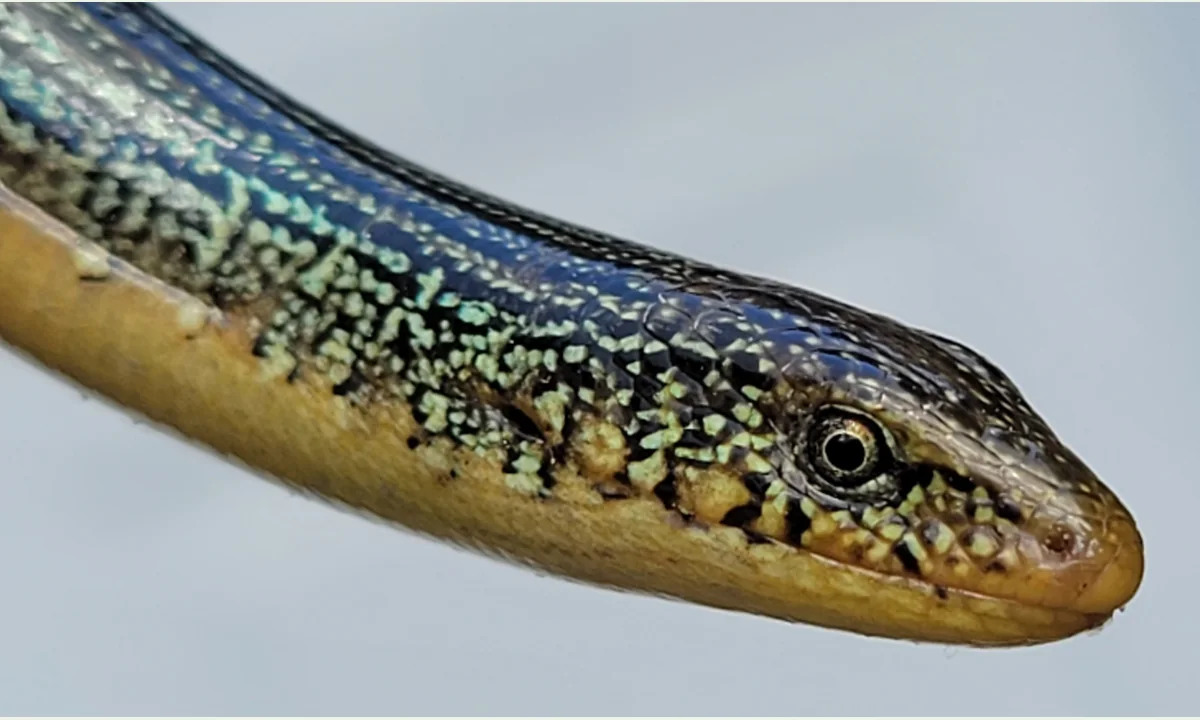

Which differences are useful in an existing image?
- External ear opening
A glass lizard has an external ear opening behind the eye. A clean side image may show it; a top view, shadow or low-resolution frame may not. Do not label an uncertain dark spot as an ear or conclude “snake” because the side of the head is out of view.
- Movable eyelids
Glass lizards can close their eyelids; snakes do not have movable eyelids. An existing clear video of a blink can be useful. A still image of an open eye does not demonstrate whether an eyelid moves. Do not tap, poke or provoke the animal to make it blink.
- Tail appearance
UF/IFAS explains that glass lizards may shed a tail when threatened. UGA notes that regenerated eastern glass-lizard tails can have a brown tip. This means an incomplete or differently colored tail need not match a full-tail reference image. It does not make a short tail an identification test.
Never pull a tail, lift the animal or attempt a “break-off” test. A defense response described in a biology source is not a demonstration for a homeowner to reproduce. Nor should you use apparent stiffness, movement style or a quick glimpse of color as permission to handle an unknown reptile.
Why a striped example will not fit every glass lizard
UGA's eastern glass-lizard account describes age- and sex-related differences in stripes and speckling. UF/IFAS also describes multiple glass-lizard species in Florida. That is why this page gives one broad comparison rather than promising that every individual has the same lines, green color or tail proportions.
The eastern example shown here comes from South Georgia. UGA places eastern glass lizards in much of the Southeast, particularly Coastal Plain and Piedmont settings. A location outside the example's described range needs its own regional check; it should not be assigned the same species simply because the animal is legless.
A useful identification request
Send the original photograph or recording with the state/county and date, whether the animal was indoors or in the yard, and whether the head, side of the head and full tail are visible. Do not add an estimated size unless you have a reliable existing reference; do not place a ruler beside the animal.
Ask a local Extension or wildlife identification service what the image supports and which features remain unseen. If the animal has left and the only frame is blurred, a limited or unresolved answer may be the appropriate result. Do not pursue it to finish a comparison chart.
What to do while the identity is uncertain
Give it space and keep children and pets away. UGA's snake-safety guidance warns against handling or harassing snakes; do not treat a tentative glass-lizard guess as an exception. For an animal indoors or in an unavoidable work area, ask the appropriate local wildlife responder about a safe response rather than using a tool or trap from a generic removal guide.
If it is outdoors and not creating an immediate conflict, observation does not require capture or a control action. This article does not certify the animal as harmless, authorize relocation or turn a photograph into permission to disturb it. This page is specifically about the legless-reptile confusion, not a complete guide to Florida lizards or snakes.
Sources and limits
Sources reviewed October 23, 2026 (U.S. Eastern date). UF/IFAS supplies the basic glass-lizard/snake distinction and tail-defense context; UGA supplies the eastern species variation and regional scope. No size threshold, stripe rule, legal status or bite-treatment advice is offered. The licensed head photograph is not a complete-body comparison or a picture taken by this website.