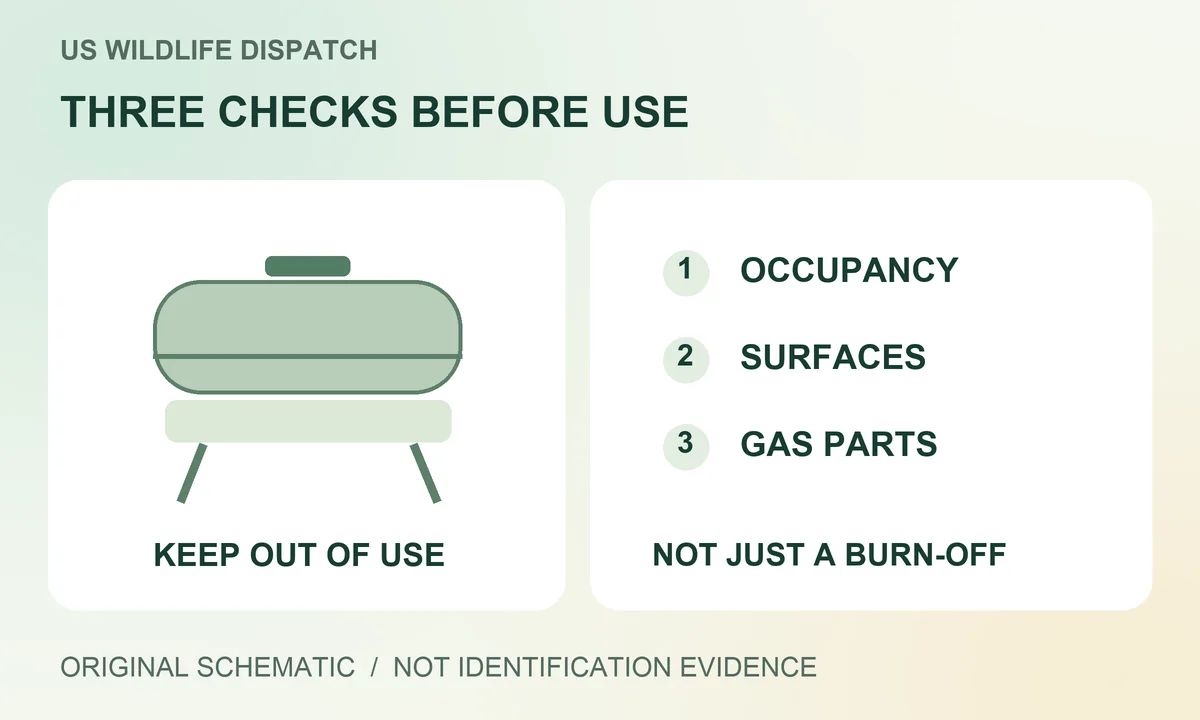
The question is not simply how hot to run the grill. There may be an animal inside, contaminated material on different surfaces, and components that need checking. Those are separate jobs, even if one provider agrees to handle more than one.
What did you actually find?
From a safe position, record the location: cooking grate, grease tray, cabinet floor or an opening near the burner area. “Material beneath the grate” is more useful than an unconfirmed diagnosis of mice. Small dark objects can also be mistaken for waste; do not crumble, sniff or handle them to decide.
If an animal is visible or disappears into an inaccessible part, step back and keep children and pets away. Ask a suitable wildlife responder how to resolve the animal question. Closing, moving or operating the appliance is not a substitute for knowing where it is.
Why “burn it off” is not the whole answer
A Weber storage article, available on its Indonesia site, describes mice using idle grills and recommends removing food residue before storage. It also gives a general cleanup-and-heating suggestion. CDC's rodent guidance separately warns against dry sweeping or vacuuming urine, droppings and nesting material.
Do not combine those pages into a new universal procedure. We do not adopt dry brushing of suspected rodent waste or supply a burn-off time. A storage tip is not confirmation that hidden material, a particular food-contact surface or a damaged gas component has been addressed.
For confirmed or suspected rodent contamination, use the current CDC source as the cleanup starting point and ask the manufacturer how the method applies to each affected material. Do not assume that a household disinfectant is suitable for a cooking grate, coating, hose or electronic component. Keep any product label and the model's care instructions with that discussion.
Ask for three separate answers
- Animal status: is a live animal still present or is that unresolved? Do not ask the cleaner to infer vacancy from a quiet cabinet.
- Contamination scope: which surfaces and materials were affected, which can be addressed by the proposed method, and which need replacement or further advice?
- Equipment condition: what checks does the manufacturer specify before this model is used again, and who is qualified to perform them?
CPSC's gas-grill fact sheet identifies hose damage, leaks and burner-tube obstruction as safety-check subjects and says to follow the grill's instructions. This page does not teach gas-line repair, leak testing or probing a burner. If a leak is detected, CPSC says not to light the grill until it has been repaired.
Do not add an improvised screen, foam, steel wool or tape to an opening because it appears large enough for an animal. Ask the manufacturer what function that opening serves and whether an approved exclusion solution exists. Our opening-function guide explains why a required opening differs from a building defect; it is not a grill modification specification.
A useful message before booking work
Our gas grill is [model]. We found [visible material] at [location] after [period of non-use]. We have not lit, brushed or dismantled it. [A live animal was seen / occupancy is unresolved]. Can you separate the contamination work from the manufacturer's pre-use equipment checks and explain any limits?
Ask who will address food-contact surfaces and who will assess concealed areas. If the person offering the work only cleans accessible surfaces, record that limitation instead of assuming a full appliance inspection is included.
Before putting it back into storage
After the current problem has been resolved, follow the actual model's food-residue, grease and storage instructions. Weber's general storage article treats leftover food as an attractant; it does not establish that every repeat visit is caused by poor cleaning or that a cover excludes rodents.
Do not relocate a propane cylinder into the house or garage as a pest-prevention measure. CPSC warns against indoor LP-container storage. A different fuel type, electric grill or pellet appliance requires its own instructions; this gas-grill page is not permission to adapt one model's method to another.
Sources and review scope
Sources reviewed October 21, 2026 (U.S. Eastern date): CDC rodent cleanup, Weber's general storage article and CPSC Gas Grill Fact Sheet, publication 467, revised 2013. The CPSC document supplies general safety principles, not an inspection of a current model. The cleanup differences are stated above; no chemical recipe, heating clearance, warranty decision or tested exclusion product is supplied.