The immediate task is to manage the yard around a possible nursery—not fill a hole, move the babies to a hedge or determine an exact age from an online photograph. This guide concerns suspected wild-rabbit lawn nests, not escaped pet rabbits or every underground burrow.
Pause the work before investigating further
Tell anyone using a mower, trimmer, rake or other lawn equipment where the suspected nest is. Do not uncover it repeatedly to obtain a count. Keep the location out of routine pet routes and children's play while you obtain appropriate advice.
If a lawn contractor is due, notify them before arrival. A clear work instruction is better than assuming a small patch will be noticed from a running mower. Do not put equipment or a heavy cover over the site.
Why a quiet patch is not necessarily abandoned
Wildlife Illinois describes rabbits making shallow lawn nests with grass and fur. Appearance alone is not enough to identify every depression, and dimensions are not a reliable do-it-yourself age or species test.
Humane World explains that mothers spend substantial time away from their young and that babies found alone are often not orphaned. Do not take them indoors solely because no adult appeared during your observation. We do not supply a number of waiting hours that proves a nest safe or abandoned.
Make the temporary yard routine specific
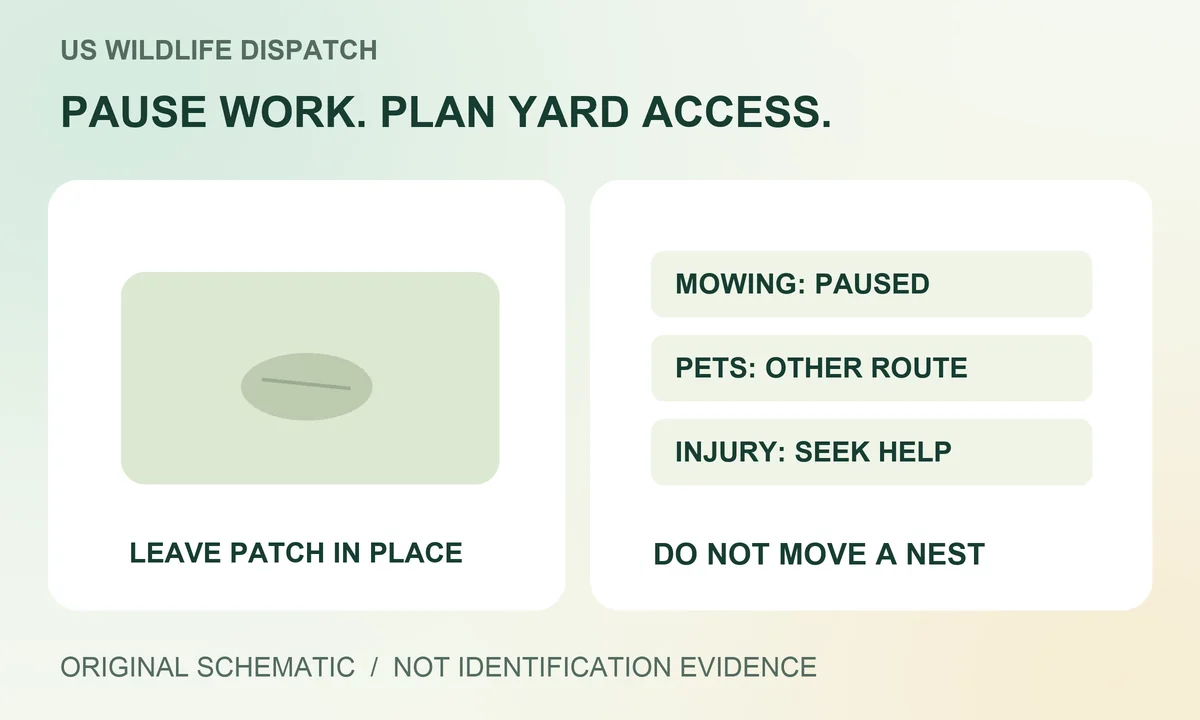
- Mowing: identify the affected area to the person doing the work and postpone work there. Do not mow over a nest because the blade is set higher.
- Pets: use another part of the yard or a controlled route that avoids the site. Supervise rather than relying on a pet to ignore it.
- Other chores: pause raking, digging, bed edging and material delivery in the affected area.
- Shared responsibility: tell the next person what remains uncertain and who is obtaining wildlife advice.
This is a household coordination checklist, not a tested exclusion perimeter. Do not build a sealed cage, place netting over the nest or create a barrier that prevents the mother from returning. Ask a rehabilitator about the actual layout if ordinary pet separation is difficult.
If a mower or pet has already disturbed the site
Stop the equipment, bring the pet away and contact a licensed wildlife rehabilitator or your state wildlife agency for instructions. Use the state-by-state wildlife rehabilitation directory to find a contact; call before attempting transport and confirm whether they can advise on rabbits. Tell them what actually occurred: whether a blade passed over the site, an animal was picked up by a pet, or the covering was disturbed without known contact.
Do not assume an animal is uninjured because it moves. Humane World specifically advises seeking qualified help after pet contact and avoiding attempts to feed the rabbit. This page does not provide treatment, feeding, warming, handling or transport instructions.
If a person was bitten, scratched or otherwise potentially exposed while intervening, obtain medical or public-health advice. For a pet's own possible injury or exposure, contact its veterinarian.
When can the patch be mowed again?
Do not set a removal date from the discovery day. You may have found the nest partway through its use, and small animals elsewhere in the grass still need consideration. Ask the wildlife adviser what site-specific signs or follow-up they require before normal work resumes.
Once the relevant uncertainty is resolved, keep the conclusion and date with your yard-work instruction. A normal lawn routine can resume only as appropriate for the actual site; we do not certify a fixed age, calendar month or universal clearance interval.
Do not confuse a nursery with the yard's other damage
For a separate persistent hole, retain its location and observations as a different record. Filling every depression to prevent animals can conceal an occupied site. The fence-hole assessment addresses another task and is not permission to fill this nest.
This topic is not an autumn outbreak claim. Rabbit breeding and lawn use vary by location and conditions; the guide is intended for the situation when it actually occurs.
Sources and limits
Reviewed October 22, 2026 (U.S. Eastern date): Wildlife Illinois's lawn-nest distinction, Humane World's nest and pet-contact guidance and CDC exposure advice. We have not inspected a nest, diagnosed an injury or confirmed local handling permissions.