Composting does not have to mean accepting unrestricted food access. But there are two different jobs: resolving the current animal problem and designing a manageable compost system afterward. Buying a new lid does not establish that the animal is gone or that nearby supplies are protected.
Keep a visit separate from a confirmed nest
Record what you saw: one animal at the base, material pulled through an opening, accessible food or repeated passage. “A hole beside the bin” is not enough to identify a rat or establish its depth. Do not probe it or disturb material to obtain a more confident label.
Pause routine turning where a live animal, suspected nest or unknown wildlife waste is present. Get suitable pest or wildlife advice about that situation. Routine instructions for aerating ordinary compost are not instructions for disturbing an occupied or contaminated pile.
What belongs in this kind of compost?
EPA's backyard-compost guide distinguishes home systems from commercial facilities. It lists meat, fish, bones, dairy and fats among materials to avoid, with animal attraction among the reasons. An item accepted by a municipal program is not automatically suitable for an open backyard pile.
For an ordinary, unoccupied system, EPA describes covering food scraps with carbon-rich material and maintaining a suitable mix. These are compost-management measures, not clearance of an existing rat problem. A hot center, earthy smell or layer of leaves is not proof that hidden material is free of wildlife waste.
Do not put dead rodents, suspect feed, pet waste or animal bedding into a household pile as a disposal shortcut. Check the specific disposal or collection guidance for that material. If a seed bag nearby was affected, the feed-storage guide covers the different food-disposal decision.
Inspect the container without making an animal trap
Once access is safe to assess, describe the lid, side panels, loading hatch and base separately. Does the lid actually seat? Is a panel damaged? Is the base open, broken or simply not visible? “Enclosed composter” is a product description, not a check of the installed unit.
EPA's rodent-prevention section discusses a lid and potentially a floor. Ask how any proposed modification preserves the system's intended operation and can be maintained. This page does not give a universal mesh, flooring or underground-barrier specification.
Do not retrofit around an animal still inside. A competent assessment may need to address activity first, then installation. Keep the present occupancy question explicit rather than closing every gap and hoping that solves it.
Check the handling chain, not just the finished pile
- Kitchen storage: how are new scraps held before being taken outside? Use a closed container as EPA describes, rather than leaving an open bowl beside the affected bin.
- Transfer: note ordinary spills between the kitchen container and compost system. Do not clean suspected wildlife waste as if it were dropped vegetable peel.
- Inputs: keep a short list of what has actually been added. Ask the local program about items the household system should not receive.
- Container condition: record defects and uninspected parts without reaching into them.
- Other food points: note ordinary garbage, stored feed and fallen produce separately. The nearest compost bin may not be the only accessible food source.
Those prompts are our household planning aid. They are not proof of what attracted a particular rat, a neighborhood infestation count or a required municipal inspection form.
Can you keep composting while this is resolved?
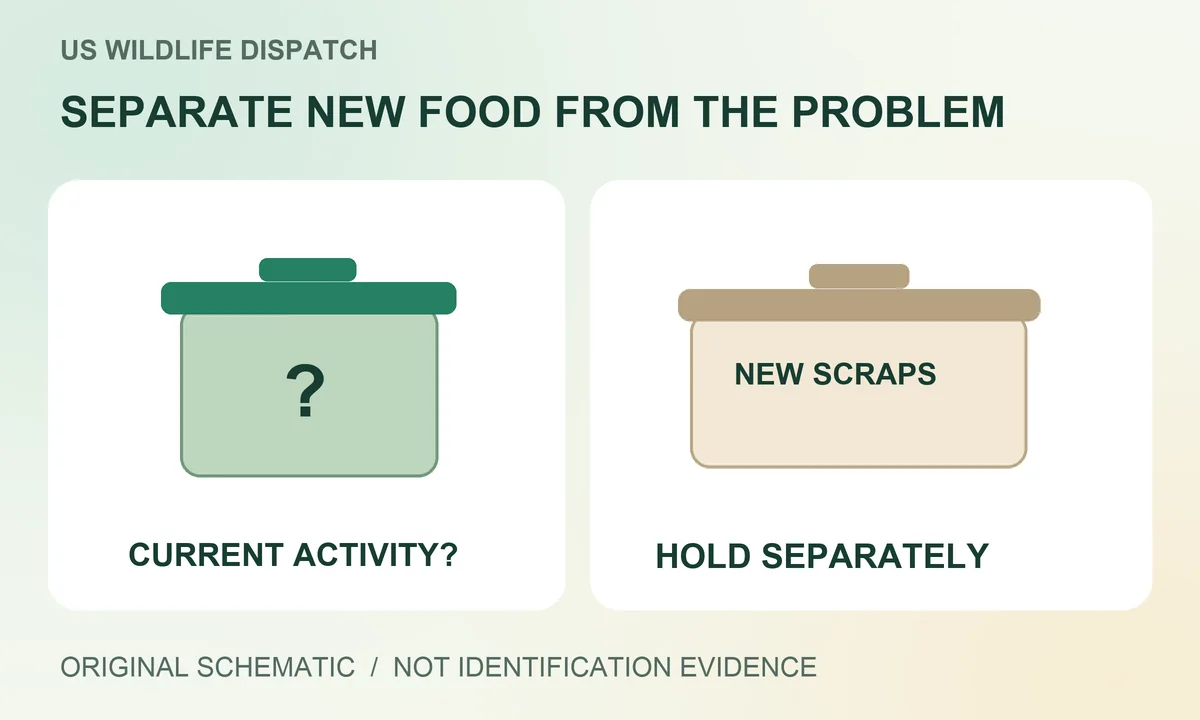
You can keep suitable new scraps separate in a closed container and check a local collection or drop-off option's accepted materials and storage rules. EPA lists municipal and community programs as alternatives where home composting is not practical. Do not transfer suspect material from the affected pile into a shared program without asking.
After the animal situation and any contamination have been addressed, agree who will maintain the system and check for new activity. Keep dated observations of the repaired container and later visits. One quiet evening does not demonstrate permanent exclusion.
Sources and limits
Sources reviewed October 23, 2026 (U.S. Eastern date): EPA: Composting At Home, backyard inputs, rodent prevention and alternatives and CDC: rodent-cleanup precautions. CDC's material-specific precautions are a separate task, not a recipe for disinfecting garden compost. This guide supplies no poison, trapping, disease diagnosis or approval to use a contaminated pile. The record and work sequence are editorial, not an inspection.