Quick Answer
Size and the tail settle it. A red squirrel is noticeably smaller — about 7–9 inches of body, 5–7 ounces — with a reddish coat, a buffy white eye-ring, and a white-bordered tail. It is the tree squirrel that lives in conifers and hardwood forests, and it has ear tufts in winter. An eastern gray squirrel is bigger (8–11 inches of body, 1‑1¼ lbs), gray over a white or cream belly, with a big, fluffy, bushy tail that is light-fringed. The red squirrel is noisy and territorial; the gray is the common yard squirrel of towns and parkland.
Red Squirrel vs Gray Squirrel: Two Eastern Tree Squirrels
Across the eastern United States and into the Appalachians of West Virginia, two tree squirrels put bushy tails in front of backyard bird feeders and in the crowns of hardwoods: the eastern gray squirrel (Sciurus carolinensis) and the American red squirrel (Tamiasciurus hudsonicus). People routinely blur the two because both are gray-brown tree climbers, but they differ clearly in size, color, habitat, and personality. The West Virginia Division of Natural Resources (WVDNR) and West Virginia University (WVU) Extension list both among the state's small game, and knowing which one is raiding the seeds, stripping bark, or digging in a flower bed changes how you deal with it — and whether control is even worth it.
Quick Comparison Table
| Feature | Red Squirrel | Eastern Gray Squirrel |
|---|---|---|
| Body size | 7–9 in., 5–7 oz | 8–11 in., 1–1¼ lbs |
| Coat | Reddish to russet above, grayish sides, white/buffy underside | Grizzled gray above, white or cream belly |
| Eye ring | Prominent buffy white eye-ring | No eye-ring |
| Tail | Medium, flat-lying, edged with white/red | Large, fluffy, bushy, light-fringed |
| Winter ear tufts | Yes — long tufts over the ears in cold months | No tufts (ears exposed) |
| Habitat | Conifer and mixed hardwood forest, mountains | Town parks, suburbs, yards, oak-hickory forest |
| Behavior | Territorial, noisy churr "scolding," caches cones | Social, cheek-pouch caching, learns bird feeders |
| Predator sign | Conifer cone caches, stripped-cone middens at log bases | Shovel-digging for buried nuts, raided bulbs |
The Eastern Gray Squirrel: The Common Yard Squirrel
The eastern gray squirrel is the big, bustling squirrel of city parks, suburban yards, and oak-hickory woods across West Virginia. It is slate-gray over the back with a white or cream belly, measure about 8 to 11 inches of body with a pronounced, fluffy tail as long as the body, and weighs in at roughly a pound to a pound and a quarter. Melanistic (all-black) gray squirrels occur in some eastern cities; that black form is still the same species, not a red squirrel.
Gray squirrels are adaptable and social, learn to work bird feeders, and cache buried nuts, which they retrieve by smell — the shallow, shredded digging in flower beds and planter soil is gray squirrel (or chipmunk) work. They are the squirrel most people literally mean when they say "a squirrel in my yard."
The Red Squirrel: The Noisy Mountain & Conifer Squirrel
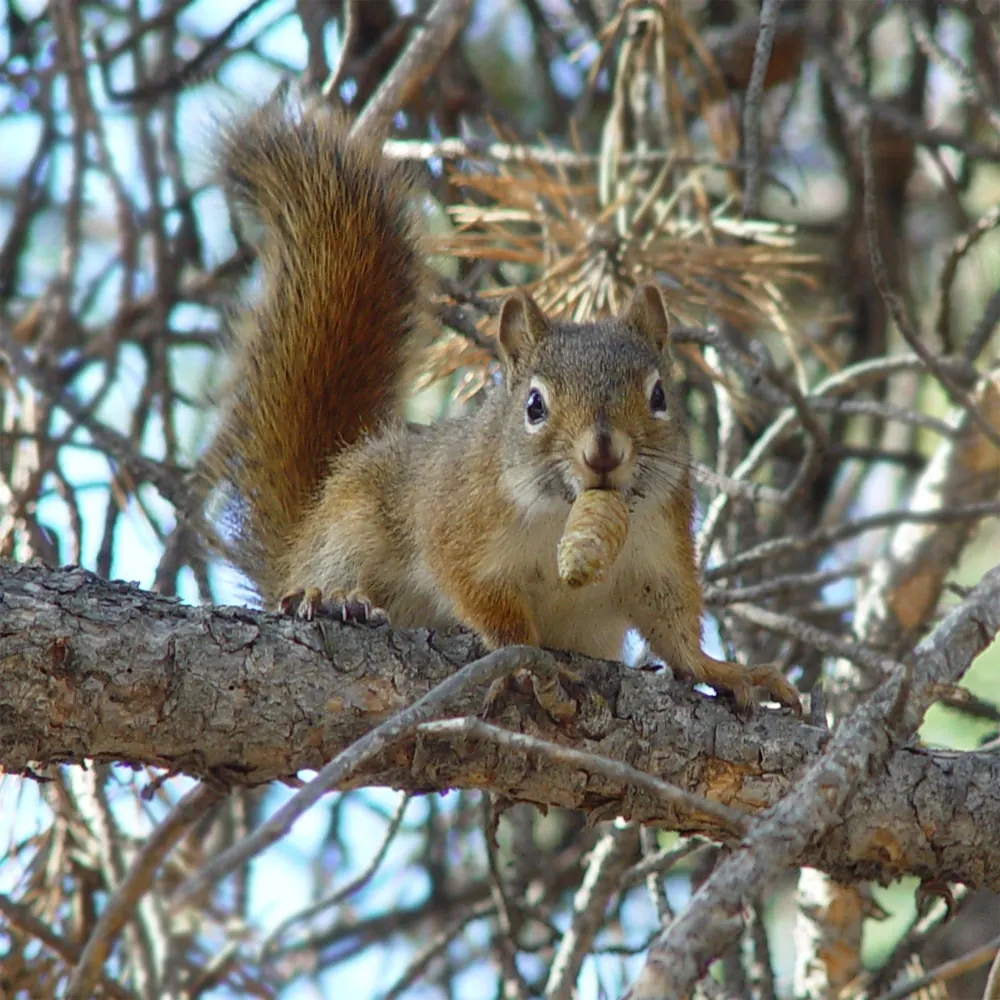
The American red squirrel is smaller and sassier. It runs about 7 to 9 inches of body at 5 to 7 ounces, with reddish to russet fur over the back, lighter grayish sides, and a plain white or buffy underside. The telltale mark is a narrow buffy white ring around each eye and, in winter, prominent ear tufts that stick up over the ears. Its tail is medium-length and flattens against the body rather than standing in a big plume, and it is edged with white or red.
Red squirrels are creatures of conifers and mixed hardwoods, favoring the higher forested ridges of the Alleghenies and Appalachian Mountains. They are fiercely territorial and famously noisy — that rattling, rising-falling churr or "scold" you hear from a treetop is usually a red squirrel, and it is the one that descends a tree to hurl threats (or fir cones) when you walk near its territory. They cache fir and pine cones in big middens at the base of logs or rock piles, a signature an outdoorsperson learns to read.
Tracks, Sign, and Sounds in the Yard
Tracks are a poor separator because both squirrels bound in the same way and, in snow or mud, a red squirrel print is just a smaller version of a gray squirrel print — the reliable tell is size, about ¾ to 1 inch for red versus 1¼ inches or more for gray, and a gray squirrel's hind foot is noticeably longer. Sign is better: cone-scale middens point to red squirrels; shallow mulch-digging for buried nuts and shredded bulbs point to gray squirrels. Sound is easiest: the sharp, rhythmic churring scold is a red squirrel, while a gray squirrel makes softer barks, chucks, and foot-stomping tail-flips. For how squirrel feeding and caching damage compares with the clean digging of moles and voles, and what to do about the animals actually excavating turf, see our Mole vs Vole vs Shrew Damage Guide and our West Virginia Yard Digging & Wildlife Damage Guide.
FAQ: Red Squirrel vs Gray Squirrel
Do red squirrels live in West Virginia?
Yes. American red squirrels inhabit the state's forested, mountainous country, especially in conifers and high-elevation mixed hardwoods of the Allegheny Mountains. Gray squirrels are widespread everywhere from towns to oak-hickory woods.
How can I tell a red squirrel from a gray squirrel at a glance?
Size and color. A red squirrel is much smaller, reddish overall, with a white eye-ring and winter ear tufts. A gray squirrel is larger, gray with a white belly, and has a big fluffy tail with no eye-ring.
Can a gray squirrel be red or black?
Yes to black. Melanistic (all-black) eastern gray squirrels occur in some cities, still the same species. True red squirrels stay reddish regardless — a red-colored gray squirrel is not a red squirrel.
Which one sounds like a rattling churr?
The sharp, rapid-fire scolding churr from a treetop is the American red squirrel. Gray squirrels make softer barks, throaty chucks, and a distinctive foot-stamping, tail-flip alarm rather than a continuous rattle.
Are squirrels protected in West Virginia?
Gray squirrels are a small-game species with hunting seasons set by WVDNR. Red squirrels are also harvested in small numbers under small-game rules. Nuisance squirrels around the home are handled differently — check current WVDNR rules before trapping any squirrel, and focus on exclusion for attic entry.
Why is a squirrel digging small holes in my flower bed?
Shallow, messy digging in loose soil is a squirrel (or chipmunk) retrieving cached nuts and seeds, not a vole or mole. Gray squirrels are the usual suspect in a yard. If the holes are neat, deeper, and in grass with raised ridges, that points to a mole or vole instead — see the comparison guides above.
Sources: West Virginia Division of Natural Resources (WVDNR), West Virginia University (WVU) Extension, Cornell Lab of Ornithology, and USDA Forest Service squirrel references. This guide is for informational purposes only and does not constitute professional wildlife management advice.