Quick Answer
Wyoming's most common yard diggers are American badgers (the state animal), Wyoming ground squirrels, thirteen-lined ground squirrels, northern pocket gophers, and meadow voles; in eastern Wyoming black-tailed prairie dogs dig colony burrows; striped skunks leave small grub-hunting pits.
Identifying Yard-Digging Wildlife in Wyoming
When holes appear in a Wyoming yard, the culprit is almost always one of a handful of native mammals adapted to the state's varied landscapes, from high-elevation sagebrush basins to shortgrass prairies. The Wyoming Game and Fish Department (WGFD) and the University of Wyoming Extension serve as the state's authoritative sources for wildlife identification and management guidance. Both agencies emphasize that accurate identification of the digging animal is the essential first step before any control measure is considered, as different species require entirely different approaches and legal considerations.
Key Identification Tip: Look first at the hole itself and its surrounding soil pattern. A big, deep burrow with pushed-out soil in a rough fan shape points to an American badger. A small tunneled hole with a fan of loose dirt and a distinct soil plug blocking the entrance indicates a northern pocket gopher. A clean, round hole near a burrow mound within a larger colony of similar holes suggests black-tailed prairie dogs in eastern Wyoming. Tiny 1–2 inch holes connected by surface runways through grass are meadow vole activity. Scattered, shallow cone-shaped pits across a lawn are classic striped skunk foraging digs for grubs and insects.
Identification Table: Wyoming Yard Diggers
| Animal | Hole Size & Shape | Depth | Damage Pattern | Wyoming Range |
|---|---|---|---|---|
| American Badger | Large, oval to irregular, 8–12 inches wide | 2–6 feet deep | Large excavated pits with pushed-out soil mounds; torn-up sod; multiple entrances | Statewide, all habitats |
| Wyoming Ground Squirrel | Round, 3–4 inches wide | 1–3 feet deep | Multiple holes near sagebrush; scattered loose soil; chewed vegetation nearby | Western and central Wyoming, high-elevation sagebrush |
| Thirteen-lined Ground Squirrel | Round, 2–3 inches wide | 1–2 feet deep | Small holes in shortgrass lawns; little or no mound; runways through grass | Eastern and central Wyoming, shortgrass prairie |
| Northern Pocket Gopher | Tunnel hole 2–3 inches, often plugged | 6–12 inches below surface | Fan-shaped mounds of loose dirt; soil plugs; dying plants along tunnel lines | Statewide, especially irrigated fields and lawns |
| Black-tailed Prairie Dog | Round, 4–6 inches wide | 3–6 feet deep | Colony of burrow mounds; vegetation clipped low around holes; distinct dirt rim | Eastern Wyoming, shortgrass prairie |
| Meadow Vole | Small, 1–2 inches wide | Shallow surface runways, burrows 2–4 inches deep | Runways through grass; girdled tree bases; small holes at runway intersections | Statewide, moist grassy areas |
| Striped Skunk | Shallow cone pits, 2–4 inches wide | 1–3 inches deep | Scattered small pits across lawn; rolled-up sod patches; no mounds | Statewide, near water and cover |
American Badger (Taxidea taxus)
The American badger holds the distinction of being Wyoming's official state animal, a fitting tribute to a creature that embodies the rugged character of the high plains. Badgers are powerfully built members of the weasel family, with low-slung bodies, broad heads, and distinctive 2-inch front claws that make them among the most efficient diggers in North America. They use these formidable claws to excavate burrows in pursuit of ground squirrels, pocket gophers, and other burrowing prey, often digging with astonishing speed.
In a yard setting, badger damage is unmistakable. Their diggings appear as large, irregular excavations that can measure 8–12 inches across and extend several feet deep. The displaced soil is pushed out in rough mounds, and the surrounding sod is often torn and upended. Badgers are not colonial animals; a single badger may maintain several burrows within a territory and return to them periodically. They are most active at dawn and dusk, though they may dig at any hour when prey is abundant.
Because badgers are the state animal and classified as a furbearer by the WGFD, they receive legal protection. Homeowners experiencing badger damage should contact the WGFD for guidance before taking any action, as trapping requires appropriate licensing and adherence to season dates.
Wyoming Ground Squirrel (Urocitellus elegans)
The Wyoming ground squirrel, sometimes called the Richardson's ground squirrel in older literature, is a high-elevation burrower that thrives in the sagebrush country of western and central Wyoming. These medium-sized rodents measure roughly 8–10 inches in length and are grayish-brown with lighter undersides. They are colonial animals, and their burrow systems create networks of holes that can undermine lawns, pastures, and hayfields.
Their holes are round, approximately 3–4 inches in diameter, and often surrounded by scattered loose soil. Unlike pocket gophers, Wyoming ground squirrels do not plug their entrances, and the holes remain open for daily use. These squirrels are true hibernators, emerging in spring and retreating underground by mid-summer in many areas. Their digging activity is therefore concentrated in a relatively short window, typically from April through July depending on elevation and snowmelt.
Wyoming ground squirrels feed on grasses, forbs, and occasionally garden crops. Their burrowing can create significant soil disturbance, and their presence attracts predators such as badgers, which may compound yard damage. The University of Wyoming Extension notes that these squirrels are unprotected nongame species, meaning landowners may control them without a license, though local regulations may apply.
Thirteen-lined Ground Squirrel (Ictidomys tridecemlineatus)
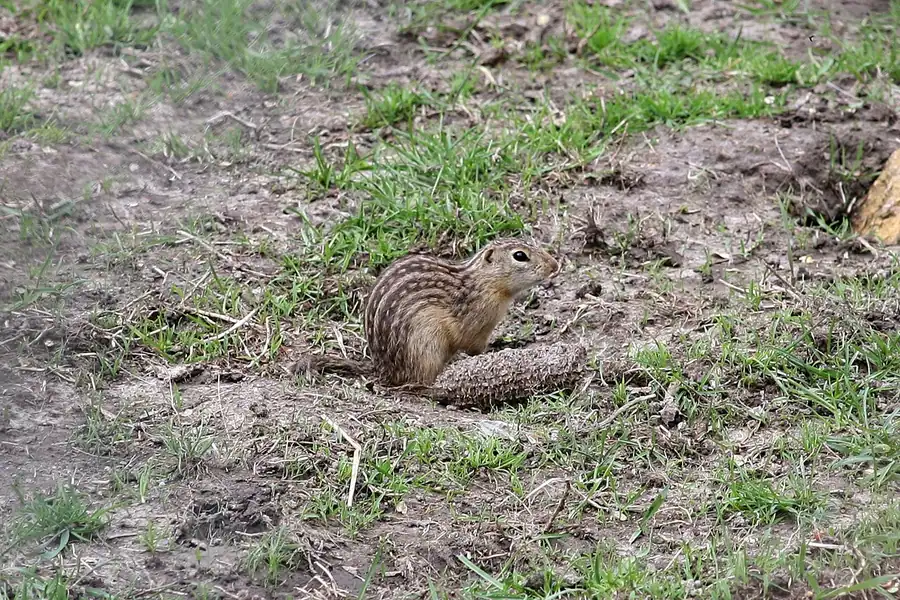
The thirteen-lined ground squirrel is a smaller, more slender relative of the Wyoming ground squirrel, named for the alternating stripes and rows of spots that run along its back. This species prefers shortgrass prairie habitats and is most commonly encountered in eastern and central Wyoming, where it inhabits lawns, golf courses, roadsides, and other open areas with short vegetation. Its range overlaps with that of the Wyoming ground squirrel in some regions, but the thirteen-lined species generally occupies lower elevations.
Thirteen-lined ground squirrels dig burrows with round entrances measuring 2–3 inches in diameter. They typically leave little or no mound at the entrance, which distinguishes their holes from those of pocket gophers. These squirrels create surface runways through grass as they travel between burrow entrances and foraging areas. Their activity is diurnal, and they are most visible on warm, sunny days.
Like their Wyoming cousins, thirteen-lined ground squirrels are hibernators with a relatively short active season. They are classified as unprotected nongame in Wyoming, allowing landowners to manage them through trapping or other legal means. Their burrows are generally shallower than those of Wyoming ground squirrels, rarely exceeding 2 feet in depth.
Northern Pocket Gopher (Thomomys talpoides)
The northern pocket gopher is a solitary, fossorial rodent that spends nearly its entire life underground. These animals are well-adapted for digging, with powerful forelimbs, large claws, and fur-lined cheek pouches used to transport soil. Pocket gophers are present throughout Wyoming, but they are most problematic in irrigated lawns, alfalfa fields, and other areas with deep, friable soils that support their preferred food plants.
The signature sign of pocket gopher activity is the fan-shaped mound of loose soil that appears above ground. Unlike ground squirrels, pocket gophers push soil out of their tunnels and then plug the entrance with a soil plug, creating a distinctive raised mound with no visible hole. These mounds are often arranged in a line or cluster as the gopher extends its tunnel system in search of roots and tubers. The tunnels themselves run 6–12 inches below the surface and can extend for dozens of feet.
Pocket gopher damage is often first noticed when plants begin to wilt or die along the path of an underground tunnel, as the gophers consume roots and sever others in their digging. The University of Wyoming Extension recommends trapping as the most effective control method for pocket gophers, using either scissor traps or box traps placed in active tunnels. Pocket gophers are unprotected nongame species in Wyoming and may be controlled by landowners.
Black-tailed Prairie Dog (Cynomys ludovicianus)
The black-tailed prairie dog is a highly social ground squirrel that lives in large colonies called towns, which historically covered vast expanses of the Great Plains. In Wyoming, these animals are found primarily in the eastern portion of the state, where shortgrass prairie provides suitable habitat. Prairie dogs are stocky, tan-colored rodents with short tails tipped in black, and they are known for their distinctive bark-like alarm call and elaborate greeting behaviors.
Prairie dog burrows are round, measuring 4–6 inches in diameter, and are surrounded by a distinct mound of excavated soil that helps prevent flooding. The entrances are typically clean and well-maintained, with vegetation clipped short in a wide radius around the burrow. Prairie dog towns can contain dozens to hundreds of burrows, and the collective digging can significantly alter the landscape. Their burrows extend 3–6 feet deep and can be quite extensive.
Black-tailed prairie dogs are diurnal and highly visible, with sentinels posting guard duty while others forage. Their conservation status has been a subject of ongoing debate, and they are subject to both state and federal management considerations. The WGFD and USDA APHIS Wildlife Services provide guidance on prairie dog management, and it is essential to check current regulations before undertaking any control measures. Poisoning prairie dogs without verifying current rules can result in legal penalties.
Meadow Vole (Microtus pennsylvanicus)
The meadow vole, also known as the field mouse, is a small, stocky rodent with a short tail, small ears, and dense brown fur. Voles are among the most prolific small mammals in Wyoming, inhabiting moist grassy areas, meadows, and lawns where dense vegetation provides both food and cover. They are active year-round, including beneath the snow in winter, and their populations can fluctuate dramatically from year to year.
Vole damage is characterized by surface runways—narrow, beaten-down paths through grass that radiate from burrow entrances. Their holes are small, typically 1–2 inches in diameter, and are often found at the intersections of these runways. Voles also girdle trees and shrubs by gnawing the bark at the base, which can kill young trees. In winter, voles may tunnel through snow, creating additional runways that become visible when the snow melts.
Unlike many other yard diggers, voles do not create large mounds of soil. Their burrow systems are shallow, rarely exceeding a few inches in depth, and are often hidden beneath grass or leaf litter. Meadow voles are unprotected in Wyoming and may be controlled by landowners. Habitat modification—reducing ground cover and keeping grass short—is the most effective long-term strategy for vole management.
Striped Skunk (Mephitis mephitis)
The striped skunk is a familiar Wyoming resident, recognized by its bold black-and-white coloration and its notorious defensive spray. Skunks are omnivorous foragers that feed heavily on insects, particularly grubs and beetle larvae, which they locate by smell and excavate from the soil. Their foraging activity is most noticeable in lawns and gardens where grub populations are high.
Skunk diggings appear as small, shallow cone-shaped pits, typically 2–4 inches wide and 1–3 inches deep. These pits are scattered across the lawn in a seemingly random pattern, and the soil is often left in small clumps rather than pushed into mounds. Skunks may also roll back sod in their search for insects, leaving patches of dead or lifted grass. Their digging is most common in late summer and fall when grubs are near the soil surface.
Striped skunks are nocturnal, so their damage is typically discovered in the morning. They are classified as furbearers in Wyoming and are also considered a rabies-vector species, which carries additional management considerations. Skunks may den under porches, decks, or sheds, and their presence near homes warrants caution. Removing food sources, such as pet food and grubs, is the most effective way to discourage skunk activity.
Seasonal Digging Patterns in Wyoming
| Season | Most Active Diggers | Why |
|---|---|---|
| Spring (April–May) | Wyoming ground squirrels, thirteen-lined ground squirrels, badgers | Ground squirrels emerge from hibernation and begin burrow maintenance; badgers follow prey |
| Summer (June–August) | Pocket gophers, prairie dogs, voles | Peak plant growth provides abundant food; gophers expand tunnel systems; voles breed rapidly |
| Fall (September–October) | Striped skunks, badgers | Grubs move closer to soil surface; skunks and badgers dig extensively to fatten up for winter |
| Winter (November–March) | Voles, pocket gophers | Voles remain active under snow; pocket gophers continue tunneling below frost line |
How to Get Rid of Animals Digging in Your Wyoming Yard
1. Identify the Animal First
Before any control measure, confirm which species is responsible. Use the identification table above, examine the hole size, shape, and soil pattern, and note the time of day when damage occurs. Photographs can help confirm identification with local experts at the University of Wyoming Extension or the WGFD.
2. Understand Badger and Gopher Trapping Rules
Badgers are furbearers managed by the WGFD with specific trapping seasons and license requirements. Pocket gophers, by contrast, are unprotected nongame species, but trapping them effectively requires placing traps inside active tunnels. The University of Wyoming Extension provides detailed guidance on gopher trap placement and technique.
3. Manage Voles Through Habitat Modification
Vole problems are best addressed by reducing cover. Keep grass mowed short, remove leaf litter and mulch piles, and create a gravel or bare-soil buffer around trees and garden beds. Installing hardware cloth around tree trunks can prevent girdling damage.
4. Remove Food Sources for Skunks
Skunks dig for grubs, so treating your lawn for grubs can reduce skunk activity. Additionally, secure garbage cans, eliminate pet food left outdoors, and seal access points under porches and decks to discourage skunks from taking up residence.
5. Use Exclusion Methods
For ground squirrels and prairie dogs, exclusion through fencing or barriers may be effective in small areas. However, these animals are capable diggers, so fencing must extend below ground. For larger infestations, professional assistance may be necessary.
Wyoming-Specific Regulations
- The American badger is classified as a furbearer managed by the WGFD, with established trapping seasons and license requirements. Taking a badger outside of these parameters is illegal.
- Wyoming ground squirrels, thirteen-lined ground squirrels, and northern pocket gophers are classified as unprotected nongame species. Landowners may control these animals on their own property without a license, though local ordinances may apply.
- Black-tailed prairie dogs have both state and federal management considerations. They are NOT to be poisoned without first checking current rules from the WGFD and USDA APHIS Wildlife Services, as regulations have changed over time.
- Meadow voles are unprotected and may be controlled by landowners through trapping, habitat modification, or other legal means.
- The striped skunk is classified as a furbearer and is also a rabies-vector species. Handling or relocating skunks requires caution and may require permits depending on the circumstances.
- A Wyoming trapping license is required to set traps for furbearers in many cases. Landowners should verify their specific situation with the WGFD before setting any traps.
FAQ: Wyoming Yard Digging
What is making mounds of dirt in my yard?
Fan-shaped mounds of loose soil with no visible hole are almost certainly the work of northern pocket gophers. These mounds are created when gophers push excavated soil to the surface and then plug the tunnel entrance. The mounds are often arranged in a line or cluster as the gopher extends its tunnel system.
What animal is digging small holes in my yard at night?
Nighttime digging is most commonly attributed to striped skunks, which forage nocturnally for grubs and insects. Their diggings appear as small, shallow cone-shaped pits scattered across the lawn. Raccoons may also dig at night, though their holes tend to be larger and more irregular.
How can I tell a badger hole from a ground squirrel hole?
Badger holes are large, typically 8–12 inches across, with substantial excavated soil pushed out in rough mounds. Ground squirrel holes are much smaller, measuring 2–4 inches in diameter, with minimal soil disturbance. Badger diggings also tend to be more irregular in shape and often involve torn-up sod.
Are badgers protected in Wyoming?
Yes, American badgers are classified as furbearers in Wyoming and are managed by the WGFD. They have established trapping seasons, and a valid trapping license is required to take them. Landowners experiencing badger damage should contact the WGFD for guidance on legal options.
Can I relocate a skunk from my property?
Relocating skunks is generally discouraged and may be illegal without proper permits. Skunks are classified as furbearers and rabies-vector species in Wyoming, which carries additional regulatory considerations. Additionally, relocated skunks often do not survive in unfamiliar territory. Focus instead on removing food sources and sealing access points.
Why do I have digging damage every year?
Recurring digging damage typically indicates an ongoing food source or habitat feature that attracts diggers. Grub infestations draw skunks and badgers, while dense ground cover supports vole populations. Sagebrush or prairie habitat adjacent to your yard may sustain ground squirrel or prairie dog colonies. Addressing the underlying attractant is key to breaking the cycle.
Professional Wildlife Removal in Wyoming
When digging damage becomes extensive, or when the offending animal is a protected species such as a badger, professional wildlife removal services may be the most practical solution. Professional removal costs in Wyoming typically range from $200–$900 depending on species, severity, and site access. Licensed wildlife control operators have the training and equipment to handle animals safely and legally, and they stay current on WGFD regulations.
For homeowners considering their options, understanding the full scope of wildlife removal costs can help in planning. See our Wildlife Removal Cost Guide: Scope and Quote Checklist for an explanation of service scopes and quote comparisons. For issues involving rodents and burrowing animals, our rodent exclusion cost guide provides information on sealing entry points and preventing future damage.
Wyoming's neighboring states face similar wildlife challenges, and homeowners near state borders may benefit from understanding regional differences. See our guides for Montana, Nebraska, and Idaho for comparative information on species and management approaches.
Sources: Wyoming Game and Fish Department (WGFD), University of Wyoming Extension, USDA APHIS Wildlife Services. This guide is for informational purposes only and does not constitute professional wildlife management advice.