Bobcat vs House Cat: Size and Identification Guide (2026)

Fact-Checked Last reviewed: July 24, 2026

Quick Answer

Bobcat vs house cat identification guide (2026). Bobcats are 2-3x larger (15-35 lbs vs 8-18 lbs), with a stubby 4-7 inch bobbed tail, black ear tufts, cheek ruff, spotted white belly, and longer legs. Learn to distinguish by tail, ears, size, and behavior.

Quick Answer

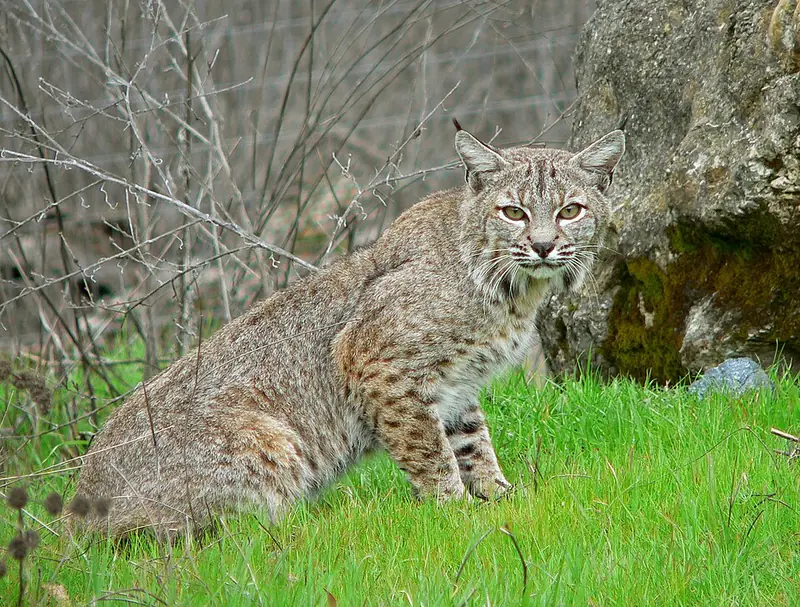
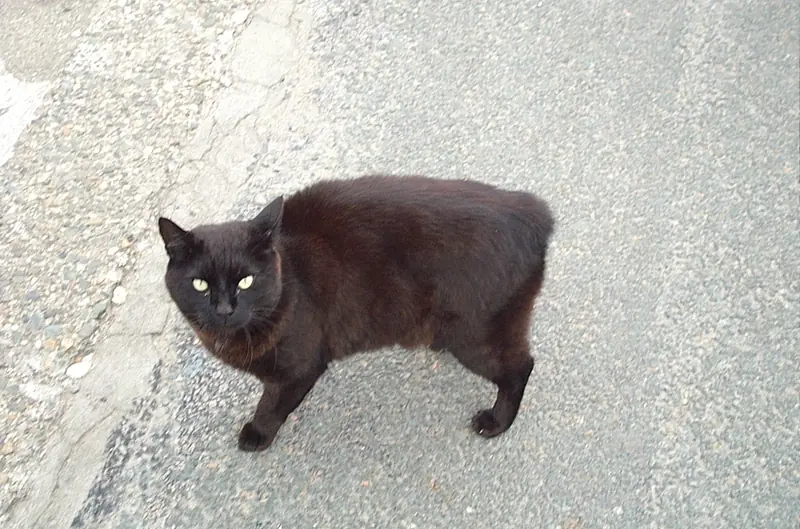
Bobcats (15-35 lbs) are 2-3 times larger than even the biggest house cats (8-18 lbs), with a stubby 4-7 inch "bobbed" tail (vs a house cat's long tail), prominent black ear tufts, a ruffed face with sideburns, longer legs, spotted coat pattern, and they hold their tail down when walking. The single most reliable identifier: a bobcat's tail is always short (under 7 inches) with a black tip on top and white underneath, while a house cat's tail is long (10-15 inches) and proportional to body length.

Why Identification Matters

Correctly distinguishing a bobcat from a house cat is important for safety, pet protection, and wildlife management. Bobcats are wild predators that can injure humans and pets if cornered, and they hunt small pets (cats, small dogs, chickens) as prey. House cats are domestic animals that pose no threat to humans. Misidentification can lead to either unnecessary fear of a neighborhood cat or dangerous complacency around a wild predator.

For comparison with another common suburban wild feline, see our coyote vs wolf visual identification guide and our deer vs elk vs moose identification guide for related wildlife identification techniques.

Size Comparison: The Most Obvious Difference

Size is the most obvious difference, but distance can make a bobcat appear similar in size to a house cat. Always look for size reference objects (a fence post, mailbox, or known-size animal) when making an identification.

MeasurementHouse Cat (Domestic)Bobcat
Body Weight (Adult Male)9-18 lbs ( Maine Coon up to 25 lbs)20-35 lbs (exceptionally 40 lbs)
Body Weight (Adult Female)7-12 lbs15-25 lbs
Body Length (nose to tail base)14-18 inches20-30 inches
Shoulder Height9-12 inches16-22 inches
Tail Length10-15 inches (long, proportional)4-7 inches (short, "bobbed")
Total Length (with tail)24-33 inches24-37 inches

Quick mental test: If the animal looks like a normal house cat or even a large Maine Coon, it is a house cat. If it looks like a small lynx or a "leggy" cat with a stubby tail, longer than a domestic cat at the shoulder, it is a bobcat. A bobcat at shoulder height of 18-22 inches stands taller than a typical kitchen counter stool.

The Tail: The Single Most Reliable Identifier

The tail is the single most reliable feature for distinguishing a bobcat from a house cat at any distance. Bobcats are named for their characteristically short, "bobbed" tail.

Tail FeatureHouse CatBobcat
Length10-15 inches (long, proportional to body)4-7 inches (short, less than half body length)
ThicknessSlender, taperedThick at base, blunt-tipped
Color patternVariable; may be solid, tabby, or multicolorBlack tip on top, white underneath; black bands visible up close
Carriage (walking)Held up or curled; often with a hook at the tipHeld down, low to ground; may swing slightly
Carriage (running)Held out behind or curved upHeld down and straight; appears as a stub

Key tip: A house cat's tail is always long and visible, often held upright when the cat is relaxed. A bobcat's tail is so short it is sometimes not visible at all from a distance, and the cat never holds it upright. If you see a cat-like animal with NO visible tail or only a stubby tail, it is almost certainly a bobcat.

Ears: Ear Tufts Are Diagnostic

Bobcat ears are distinctive and one of the easiest ways to confirm identification at moderate distances:

Ear FeatureHouse CatBobcat
Ear tufts (black tips)Absent (except in some purebreds like Maine Coons)Present — prominent 1/2-1 inch black ear tufts
Ear shapePointed, triangularPointed, triangular, with black tip and white rim
Ear back colorVariable; often lighterBlack with a white patch in the center
Ear size relative to headVariableSlightly smaller relative to the larger head

The black ear tufts on a bobcat are diagnostic — they look like small black paintbrush tips sticking up from the top of each ear. No common domestic cat breed naturally has these (Maine Coons may have minor ear furnishings, but not the prominent 1-inch tufts of a bobcat).

Face and Head Shape

Face FeatureHouse CatBobcat
Overall face shapeVariable — round (Persian) to wedge-shaped (Siamese)Broad, prominent cheek ruff (sideburns)
Cheek ruffAbsentPresent — fur extends outward at the cheeks, broadening the face
MuzzleVariable; often shortBroad, prominent whisker pads
EyesVariable color; round pupilsYellow/amber; round pupils
WhiskersLong, fineLong, thick

The cheek ruff ("sideburns") is a distinctive feature — the fur along the lower cheeks of a bobcat extends outward, giving the face a wider, more "bearded" appearance. This is absent in domestic cats.

Legs and Body Proportions

Bobcats have noticeably longer legs than house cats, particularly the hind legs:

ProportionHouse CatBobcat
Leg length relative to bodyShort to mediumLong, especially hind legs
Hind leg stanceLevel with frontHindquarters slightly higher than front ("spring-loaded" appearance)
Paw sizeSmall (1 inch wide)Large (1.5-2.5 inches wide)
Walking gaitDomestic cat walk; tail often upLong-strided, low to ground; tail down

Key tip: A bobcat's hind legs are noticeably longer than its front legs, giving it a slightly "downhill" stance from back to front. This is an adaptation for pouncing and springing — they can leap 10 feet horizontally from a standstill. A house cat has roughly level front-to-back posture.

Coat Color and Pattern

Both species show some variation, but bobcats have a consistent wild pattern that is distinct from most house cats:

Bobcat Coat

  • Base color: tawny, grayish-tan, or yellowish-brown (varies by region)
  • Black spotting on the belly and inside of legs (distinct from house cats)
  • Small black spots and streaks on the body (faint in some individuals)
  • Black banding on the upper legs ("bars" on the inside of forelegs)
  • White belly with black spots
  • Black tip on the tail (top side only)
  • Ruff of longer fur around the face and cheeks

House Cat Coat

  • Highly variable — solid, tabby, calico, tuxedo, colorpoint, etc.
  • Brown tabby is most common and most easily confused with bobcat
  • Tabby cats have stripes, not spots on the belly
  • Belly color matches body pattern (not consistently white with black spots)
  • Tail tip color matches the rest of the tail

Belly check: If you can see the animal's belly, a bobcat has a white belly with prominent black spots. A tabby house cat has a striped or matching-color belly. This is one of the most underused identification features.

Tracks: Confirming Identification

Tracks are useful for confirming bobcat presence even when the animal itself is not seen:

Track FeatureHouse CatBobcat
Track width1-1.25 inches1.5-2.5 inches
Track shapeRound, asymmetricalRound, asymmetrical (similar shape, larger)
Claw marksAbsent (retractable claws)Absent (retractable claws)
Lobe count (heel pad)3 lobes on back, 2 on front3 lobes on back, 2 on front (same shape, larger)
Stride (walking)8-12 inches12-18 inches
Trail patternDirect register (hind in front track)Direct register (same pattern, larger)

Both cats have retractable claws, so claw marks are absent in both — this distinguishes cat tracks from dog/coyote tracks. The size difference (1.5-2.5 inches vs 1-1.25 inches) is the key identifier. A bobcat track is roughly the size of a half-dollar coin; a house cat track is roughly the size of a quarter.

Behavioral Visual Cues

Behavior often confirms visual identification:

BehaviorHouse CatBobcat
Reaction to humansMay approach, ignore, or flee; some tolerate close proximityFlees immediately; rarely allows close approach
HabitatYards, porches, urban areas; near human structuresBrushy areas, edges of woods, rocky outcrops; avoids open yards
Activity timeCrepuscular and nocturnal; sometimes daytimeCrepuscular (dawn/dusk) and nocturnal
Hunting behaviorStalks small prey; may bring "gifts" to ownersStalks and pounces; can take prey 2-3x its own size (rabbits, house cats, small dogs)
VocalizationMeow, purr, yowlScreaming/yowling (often mistaken for a woman screaming); cannot meow or purr
Spray markingSprays vertically on objectsSprays vertically on objects (urine and scent gland secretions)

Geographic Range

Bobcats are found throughout the contiguous United States and into southern Canada and northern Mexico. They are absent only from a few heavily urbanized areas (Manhattan, dense downtown cores) and from intensive agricultural regions with no brushy cover. House cats, of course, are found everywhere humans live.

💡 Looking for professional help? Compare quotes for Fences and get free estimates from local pros.

Coexistence: Bobcats and house cats overlap in range nationwide. Bobcats are a leading predator of free-roaming house cats, particularly in suburban areas bordering wildland. Keeping house cats indoors is the most effective way to protect them from bobcat predation.

Identification Flowchart: Bobcat or House Cat?

  1. What does the tail look like? Long and proportional = house cat. Short stubby tail = bobcat.
  2. Are there ear tufts? No ear tufts = house cat. Prominent black ear tufts = bobcat.
  3. What is the size? House-cat-sized or smaller = house cat. 2x house-cat-size with long legs = bobcat.
  4. What is the belly pattern? Striped or solid = house cat. White with black spots = bobcat.
  5. Is there a cheek ruff? No = house cat. Yes, prominent sideburns = bobcat.
  6. How does it react to you? Approaches or ignores you = house cat. Flees immediately = bobcat.

FAQ: Bobcat vs House Cat Identification

Can a Maine Coon be mistaken for a bobcat?

Maine Coons are the largest domestic cat breed (15-25 lbs) and may have prominent ear furnishings, so they can superficially resemble a bobcat. However, Maine Coons always have a long, bushy tail (10-15 inches) and lack the diagnostic black ear tufts, cheek ruff, and short bobbed tail of a bobcat. If the tail is long, it is a Maine Coon or other domestic cat — not a bobcat.

Are there domestic cat breeds with bobbed tails?

Yes — the Japanese Bobtail, American Bobtail, and Manx breeds have short or absent tails. However, these breeds are uncommon, lack the bobcat's black ear tufts, lack the cheek ruff, have domestic cat body proportions, and do not have the bobcat's spotted white belly. If you see a cat-like animal with a stubby tail, also look for ear tufts, cheek ruff, and large size before concluding it is a bobcat.

Will a bobcat attack my house cat?

Yes. Bobcats are a leading predator of free-roaming house cats, especially at dawn and dusk. If you live in an area with bobcats (which includes most of the United States), keep your cats indoors — particularly at night. A bobcat can easily kill a house cat, and bobcat predation on domestic cats is well-documented by wildlife agencies nationwide.

Are bobcats dangerous to humans?

Bobcat attacks on humans are extremely rare. According to the California Department of Fish and Wildlife, fewer than 20 confirmed bobcat attacks on humans have occurred in the past 50 years in the United States. Most involved rabid animals or animals cornered by dogs. However, bobcats are wild predators and should never be approached, fed, or cornered. If you encounter a bobcat, make yourself large, make noise, and back away slowly — do not run.

What should I do if I see a bobcat in my yard?

Bobcats are generally shy and will leave on their own. Do not approach, feed, or attempt to scare the animal aggressively. Keep pets and children indoors until the bobcat leaves. Secure poultry, small livestock, and pet food. Remove brush piles and dense vegetation near your home that provide cover. If a bobcat behaves aggressively, approaches humans, or appears sick (especially during daylight hours), contact your state wildlife agency or animal control — the animal may be rabid.

How can I tell if a bobcat is living near my house?

Signs of bobcat presence include: large cat tracks (1.5-2.5 inches wide) with no claw marks; scat containing hair and bone fragments (often covered with soil or leaves); sightings at dawn/dusk of a cat-like animal with a stubby tail and ear tufts; kills of small prey (rabbits, squirrels, domestic cats) with characteristic feline kill marks (clean bite to the neck or skull); and screaming vocalizations at night that sound like a woman screaming.

Sources: US Fish and Wildlife Service, state wildlife agencies, USDA Wildlife Services, University of California Cooperative Extension, California Department of Fish and Wildlife. This guide is for informational purposes only and does not constitute professional wildlife management advice.

Share this pageShare on X
US Wildlife Dispatch Editorial Team
Research & Editorial

Our articles synthesize data from NPMA, EPA, CDC, USDA APHIS Wildlife Services, and state-level extension programs including Texas A&M AgriLife and TPWD. We do not claim firsthand pest control experience — we cite published research and regulatory guidance so you can make informed decisions.

Browse All Texas Wildlife Articles →
← Back to Home · More Articles