Quick Answer
Look at the tail, the build, and the head. A beaver has a flat, scaly, paddle-shaped tail, a heavy round body that waddles on land, and a wide blunt head with big orange front teeth. A river otter has a thick, tapered, furry tail, a long sleek body like a wet torpedo, and a small round head with a short muzzle and obvious whiskers. Beavers are vegetarians that cut trees and build dams; otters are predators that eat fish and slip through the water so fast you often only see the wake.
Otter and Beaver: Two Water Lovers That Are Nothing Alike
Rhode Island is the smallest state in the country, but it packs in a lot of wetland — the Wood River, the Pawcatuck, the many coves and salt marshes ringing Narragansett Bay. If you spend time along any of that water, you will eventually see a dark, sleek animal in the water and wonder: otter or beaver? It is the most common "what was that?" question the Rhode Island Department of Environmental Management (RIDEM) and the University of Rhode Island (URI) Cooperative Extension get from landowners.
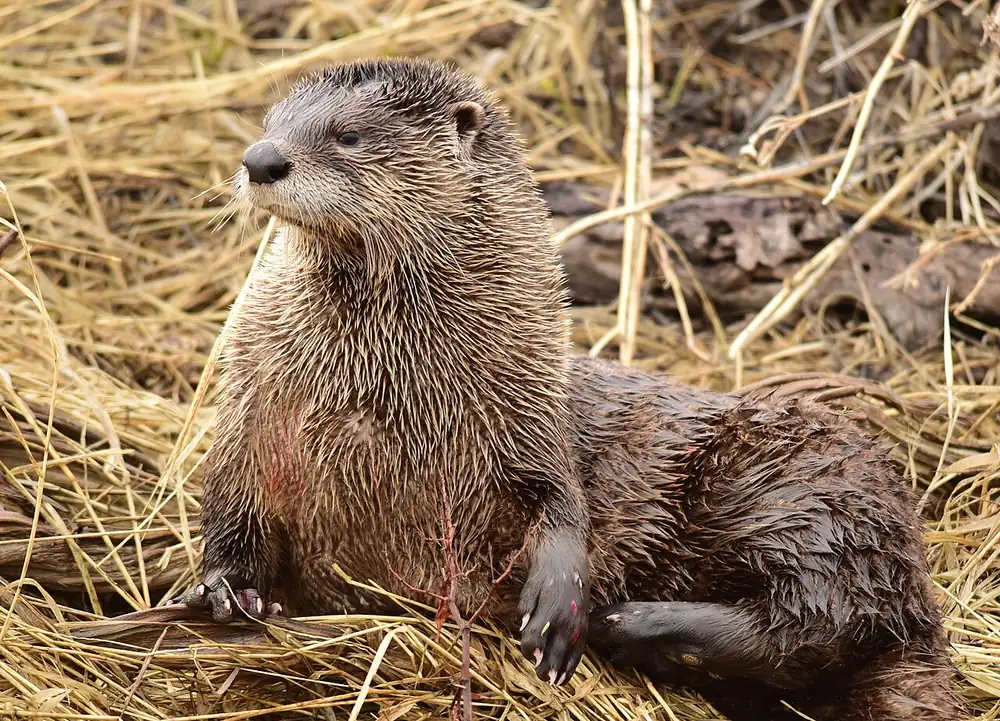
The confusion makes sense. Both are large, dark brown, water-loving mammals roughly the size of a medium dog, and both are common across Rhode Island today. But they could hardly be more different under the fur. The river otter (Lontra canadensis) is a member of the weasel family — a fast fish-eating predator. The American beaver (Castor canadensis) is a rodent — North America's biggest, a slow vegetarian that reshapes whole valleys. Once you know which family you are looking at, the rest of the ID falls into place.
Quick Comparison Table
| Feature | North American River Otter | American Beaver |
|---|---|---|
| Family | Weasel family (mustelid), a predator | Rodent family, a vegetarian |
| Adult weight | 15–30 lbs | 30–60 lbs, occasionally more |
| Body shape | Long, sleek, low to the water — torpedo-like | Short, heavy, rounded — barrel-shaped |
| Tail | Thick, tapered, furry, muscular | Flat, scaly, paddle-shaped, hairless |
| Head | Small round head, short muzzle, prominent whiskers | Wide blunt head, small round ears, big orange front teeth |
| Color | Dark chocolate-brown, paler belly, dense glossy fur | Uniform reddish- to dark-brown, coarse fur |
| In the water | Fast, dives, porpoises — often a line of ripples | Slow, floats low, tail lies flat on the surface |
| On land | Lopes with arched back, slides on mud and snow | Waddles, never far from water |
| Food | Fish, crayfish, frogs, crabs | Bark, twigs, leaves, aquatic plants |
| Signs | Belly slides, 5-toed tracks, fishy scat with scales | Chewed stumps, dams, lodges, mud-and-stick slides |
The River Otter: The Fast, Fish-Eating Predator
River otters are built like they were poured through a funnel — a long, low, muscular body three to four feet long with a thick tapered tail, short legs, and webbed feet. They are dark chocolate-brown, almost black when wet, with a lighter belly and fur so dense and glossy it looks oiled. When an otter swims, the head and a thin strip of back stay above the surface and the animal moves in a rolling, diving rhythm — often you see a line of ripples with a sleek head at the front, then nothing, then it pops up twenty yards away.
Otters are carnivores and they are good at it. They hunt fish — in Rhode Island that means whatever the river or salt marsh offers, from minnows in the Wood River to crabs in the Bay — plus crayfish, frogs, and the occasional turtle. They are playful animals. On land they lope with a humped, rolling gait and they can cover surprising distance — an otter may patrol several miles of waterway in a night.
Otters were scarce in Rhode Island for much of the 20th century. Better water quality and habitat work have brought them back across the state, and RIDEM now manages them as a furbearer with a regulated trapping season. A family of otters using a stocked pond will eat fish, and that is the main way they end up a nuisance — not by building anything, just by being very good at fishing.
The Beaver: The Big, Tree-Cutting Engineer
Beavers are North America's largest rodents and they look it. An adult weighs 30 to 60 pounds — think a heavy, round, low-slung dog — with a wide blunt head, small rounded ears that barely clear the fur, and two big orange front teeth that grow constantly. The tail is the giveaway: flat, oval, scaly, and nearly hairless, used as a rudder, a warning slap, and a fat store. In the water a beaver floats low and slow, and that flat tail often rides flat on the surface behind it like a little barge.
Beavers are strict vegetarians. They eat the inner bark of trees — willow, aspen, birch, and maple are favorites — plus twigs, leaves, and aquatic plants, and they cut whole trees to get at the bark and to build. The engineering is the part nobody forgets: dams across streams, dome-shaped lodges of mud and sticks, and canal systems. Rhode Island has plenty of beaver today, but it was not always so. They were trapped out almost completely by the late 1800s and have only recolonized over the last few decades, helped by RIDEM reintroductions, to the point where the department now fields a steady stream of complaints about flooded roads and yards.
When a beaver is disturbed or feels a threat, it slaps its tail hard on the water — a sharp crack you can hear a good distance away — and dives. That tail slap is so characteristic that if you hear a loud "crack!" by a pond and then see a flat tail sink, you are looking at a beaver, full stop.
Where You See Each One in Rhode Island
Both animals use the same kind of habitat — that is the trap. But look a little closer and they separate cleanly. Beavers need still or slow water with a ready supply of small trees, so they show up on woodland ponds, slow river backwaters, and swamps where they can build a dam and a lodge. Otters prefer flowing water and open water with fish — rivers, lakes, and the salt marshes and coves of Narragansett Bay — and they travel much farther. A beaver rarely strays far from its pond; an otter can turn up almost anywhere there is water and fish.
Rhode Island being coastal, the salt marsh is one of the best places to tell them apart. Otter tracks and slides show up on mud flats and marsh edges around the Bay; a beaver building a lodge in a tidal salt marsh is rare, though they do use the freshwater heads of coastal streams. For reading the tracks and trails both animals leave behind, our Animal Tracks in Snow Identification Guide covers otter slides and the webbed prints that separate them from other water-adjacent mammals. For the other bulky brown wetland mammals people mix up, see our Groundhog vs Beaver vs Muskrat Guide.
Tracks and Sign
Otter tracks are webbed handprints, five toes and visible claws, about 2 to 3 inches wide, usually found in a series of long, sliding belly marks — otters leave a slick groove through snow or mud between sets of prints. Their scat is dark, oily, and fishy, often loaded with fish scales or crayfish shells, and they use prominent rocks and log jams as latrine spots.
Beaver sign is almost all about chewing. Look for trees cut into a sharp pencil point at the base, stumps with chisel marks, and peeled branches floating near a dam or lodge. Beaver tracks show a big webbed hind foot and a smaller hand-like front foot, and the tail drag leaves a continuous line between sets of prints. The scat is small, round, and dry — basically compacted wood pulp — nothing like the otter's fishy smear.
When a Beaver Floods Your Yard
This is the one that actually causes problems in Rhode Island. A beaver dam backing water up onto a driveway, septic field, or lawn is a real and growing complaint, and the fix is not to go pull the dam apart — that rarely works, the beaver rebuilds in a night, and trapping or destroying a dam without authorization can violate RIDEM regulations. The standard, state-approved solution is a flow device, sometimes called a pond leveler — a perforated pipe through the dam that keeps the pond at a set level so the beaver keeps its dam but the water stops rising. RIDEM and URI Extension can point you to a licensed nuisance wildlife control operator who installs them.
Otters rarely need management, but a stocked pond or koi pool can attract them. The practical fixes are the same as for herons — netting over the pool, an electric fence wire, or removing the easy daytime cover they use to rest. Otters are fast, confident swimmers, but they are also creatures of habit; break the easy meal and they usually move on to the next reach of river.
FAQ: Otter vs Beaver
What is the fastest way to tell an otter from a beaver?
The tail. A beaver has a flat, scaly, paddle-shaped tail with no fur. A river otter has a thick, tapered, furry tail. Then look at the body: beavers are heavy and round, otters are long and sleek, and beavers have a wide blunt head with big orange teeth while otters have a small round head with whiskers.
Are otters and beavers related?
No. Otters are members of the weasel family (mustelids) and are carnivores. Beavers are rodents — the largest in North America — and are vegetarians. They are about as unrelated as two big brown water mammals can be.
Do beavers eat fish?
No. Beavers are strict vegetarians — tree bark, twigs, leaves, and aquatic plants. If you see a big dark water mammal with a fish in its mouth, it is an otter, not a beaver.
Which one builds dams and lodges?
Beavers. They cut trees with their orange front teeth and use them to build dams across streams and dome-shaped lodges. Otters build nothing; they use dens in banks, log jams, and abandoned beaver lodges, and they travel far along waterways hunting fish.
Are there otters and beavers in Rhode Island?
Yes, both are found statewide today. Beavers were trapped out in the 1800s and have recolonized over recent decades, now common enough that RIDEM handles regular flooding complaints. River otters also declined but have recovered with cleaner water and are now common along rivers and coastal marshes around Narragansett Bay.
What should I do if a beaver dam is flooding my property?
Do not destroy the dam or trap the beaver on your own — both can break RIDEM regulations and the beaver will rebuild quickly anyway. Contact RIDEM's Division of Fish and Wildlife or URI Cooperative Extension about a licensed nuisance wildlife control operator who can install a flow device (pond leveler) that holds the water at a safe level while the beaver stays. For animals digging in your yard rather than flooding it, our What Animal Is Digging Holes in My Yard guide covers chipmunks, skunks, and the other usual suspects.
Sources: Rhode Island Department of Environmental Management (RIDEM) Division of Fish and Wildlife, University of Rhode Island (URI) Cooperative Extension, USDA Forest Service. This guide is for informational purposes only and does not constitute professional wildlife management advice.