Quick Answer
Sort them by where you see them, size, and the tail. A mink is the big one — 1½ to 2½ feet long, uniformly rich dark brown, with a bushy tail and a small white chin patch, and it is closely tied to water: you see it along brooks, ponds, and marshes, swimming or slipping between rocks. A long-tailed weasel is smaller, about 9–16 inches body, with a dark-tipped tail. An ermine (short-tailed weasel) is smallest, 6–8 inches of body — in New Hampshire it turns all white in winter with a black tip to the tail, and that black tail tip against a white body is the classic ermine signature.
Mink, Weasel, and Ermine: Three Confused Mustelids
New England has three similar long-bodied weasel relatives that people routinely mix up — the American mink (Neogale vison), the long-tailed weasel (Mustela frenata), and the ermine, also called the short-tailed weasel (Mustela erminea). All three are slender, low-slung predators with short legs and a snake-like, undulating glide. The New Hampshire Fish and Game Department (NHFG) and the University of New Hampshire (UNH) Cooperative Extension both field questions about which one raided a chicken coop, left a line of tracks in the snow, or slipped through a brush pile at dusk.
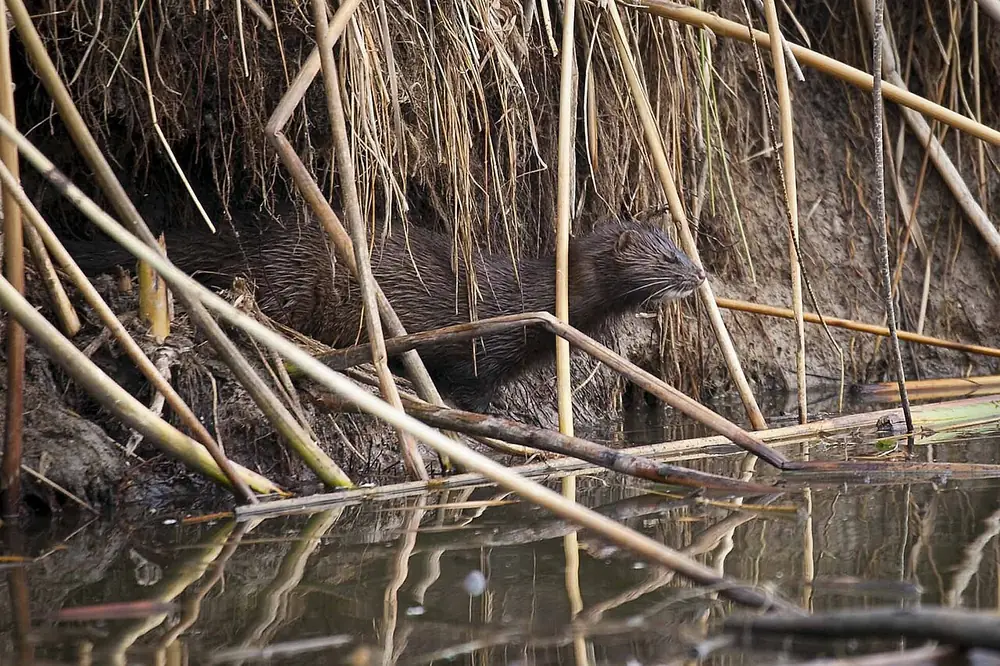
Getting it right matters partly for curiosity and partly for management. Minks need water and are the ones most often seen by the shore. The smaller weasels are the mammal specialists and turn white in winter in the north. And a shed fur or a struck chicken points to different habits — and occasionally to mink versus feral-cat versus raccoon damage, which is a different control problem entirely.
Quick Comparison Table
| Feature | Mink | Long-Tailed Weasel | Ermine (Short-Tailed Weasel) |
|---|---|---|---|
| Body length | 12–18 in. body, up to 2½ ft total | 9–16 in. body | 6–8 in. body |
| Weight | 2–3½ lbs | 6–10 oz | 2–5 oz |
| Coat / color | Rich dark brown year-round, occasionally with white belly patch | Brown in summer; turns white (with black tail tip) in winter in the north | Brown in summer; turns all white in winter, always with black tail tip |
| Tail | Bushy, dark to the tip, almost half the body | Longer (about half the body), black-tipped | Short (⅔ of body in summer), black tip |
| White chin / throat | Small white chin patch | White chin and cream throat/inner legs | Variable; belly may be cream |
| Habitat | Water-bound: rivers, ponds, marshes, streams | Wide range: fields, woods, yards, brush | Fields, rock piles, stone walls, open woods |
| Track | Larger, up to 1¼ in. long, separates in snow | Smaller, bounding pairs | Tiny, chain-like bounding pairs |
The Mink: The Water-Loving Predator
American minks are the biggest of the three and the one tied to water. An adult is 1½ to 2½ feet long including a bushy tail that makes up about a third of the length, weighs 2 to 3½ pounds, and has a rich, glossy, uniform dark-brown coat that stays dark year-round. The small white chin patch is a useful field mark, and the dark bushy tail contrasts with the whiter underfur. You find minks almost always near water — along brooks, rivers, beaver ponds, marshes, and tidal creeks — where they swim and dive, hunt muskrats, frogs, fish, and crayfish, and den in banks or muskrat lodges. In New Hampshire, that shoreline habit is usually the clue: a long brown mustelid by the water is a mink, not a weasel.
The Long-Tailed Weasel: Everywhere, Bigger Than an Ermine
Long-tailed weasels are the middle-sized hunters of New England, with a body about 9 to 16 inches long, a tail that's roughly half the body (long for a weasel), and a dark-tipped tail that sets them apart from mink. In summer they are brown above and white or cream below, with a white chin; in New Hampshire they molt to a white winter coat with the tail tip staying black — though the black tail tip tends to be longer and the winter white a little imperfect compared with a true ermine. They hunt mice, voles, and rabbits across fields, forests, and even yards, darting into burrows and rock piles, and they can enlarge a rodent tunnel to get at prey. That whole-cycle, dark-tipped tail and mid-range size is what separates a long-tailed weasel from both a mink (darker, watery, bushy-tailed) and an ermine (smaller, clearer white black-tipped tail).
The Ermine (Short-Tailed Weasel): The Winter-White Icon
The ermine is the smallest — just 6 to 8 inches of body at 2 to 5 ounces — and it is the famous one of the storybook. In summer it's brown above and cream below, but in New Hampshire's winters it molts into a clear white coat that is almost snow-pure, with the very tip of its short tail staying black. That black tail tip against white is the classic ermine mark and the origin of the name. It hunts in tight spaces — meadow vole runs, stone walls, rock piles, woodpiles — and in yards it's the grave line of small tracks threading along foundation edges and into holes. Because it's so small, an ermine is easily mistaken for a mouse or a young rat from a distance, but the long body, short legs, and white-on-black-tail habit give it away up close.
Winter Coat Changes: A New Hampshire Special
New Hampshire's deep snow brings the weasel color change that northern residents know and southern visitors ask about. The ermine and, less completely, the long-tailed weasel turn white in winter to disappear against the snow, keeping a black tail tip. What you'll usually see in December through March is a small white animal with a black-tipped tail bounding in a series of paired tracks — that's an ermine or a long-tailed weasel, not a mink and not a domestic cat. The mink stays dark all year and never becomes white in winter, so a white weasel in the snow is never a mink. For more on reading the season's tracks and separating mustelid runs from other winter trail lines, see our Animal Tracks in Snow Identification Guide.
Tracks and Sign in Yards and Snow
All three move in the classic two-by-two bounding gait of a weasel, prints landing in pairs. Mink tracks are the biggest, up to about 1¼ inches long, and beside water they often show a tail drag line; long-tailed weasel and ermine tracks are progressively smaller, with the tiny ermine leaving a neat, chained set of paired prints. All three may take over a vole hole or a small opening in a stone wall, which is easy to mistake for a separate digging problem. For how to tell a weasel that uses a mouse tunnel from the ongoing burrowing of moles and voles that created the tunnel in the first place, see our Mole vs Vole vs Shrew Damage Guide and our New Hampshire Yard Digging Guide.
FAQ: Mink vs Weasel vs Ermine
What is the difference between an ermine and a weasel?
"Ermine" is another name for the short-tailed weasel (Mustela erminea). "Weasel" most commonly means the long-tailed weasel (Mustela frenata). The ermine/short-tailed weasel is smaller, turns a cleaner white in winter, and has a shorter tail than the long-tailed weasel. Both turn white with a black tail tip in New Hampshire winters.
Does a mink ever turn white in winter?
No. Minks keep their rich dark-brown coat year-round and do not turn white, even in deep New Hampshire snow. A white weasel-shaped animal in winter is not a mink.
How can I tell if I saw a mink or a weasel?
Use habitat and size. If it was on or beside water — a brook, pond, or marsh — and a foot and a half to two and a half feet long, dark, with a bushy tail, it was a mink. If it was in a field, stone wall, or yard, smaller, and in winter white with a black tail tip, it was a weasel (long-tailed) or an ermine (smaller).
Which one attacks chickens?
Minks are the classic chicken-coop raider, known to kill far more than they eat and take birds at night; weasels will also enter coops for smaller birds and eggs but are less common at full-size poultry. Despite their size, even an ermine can kill young chicks. Secure coops with hardware cloth and seal small gaps — mustelids squeeze through openings you'd think impossible.
Are mink, weasels, and ermine protected in New Hampshire?
They are furbearer species in New Hampshire and are managed by NHFG with defined seasons and trapping license requirements. You may not trap or take them outside those rules. For damage from animals you are allowed to manage directly on your property, contact your county UNH Extension office first.
What should I do if I find one in my yard?
Enjoy it at a distance — they prey on the rodents that damage gardens and are not a threat to people. Remove attractants such as unsecured poultry, pet food, and easy denning cover such as stacked wood. If one is repeatedly entering a coop or causing real losses, exclusion with hardware cloth is the fix, and check the furbearer rules before any trapping.
Sources: New Hampshire Fish and Game Department (NHFG), University of New Hampshire (UNH) Cooperative Extension, Maine Department of Inland Fisheries and Wildlife, and USDA APHIS Wildlife Services mustelid references. This guide is for informational purposes only and does not constitute professional wildlife management advice.