Quick Answer
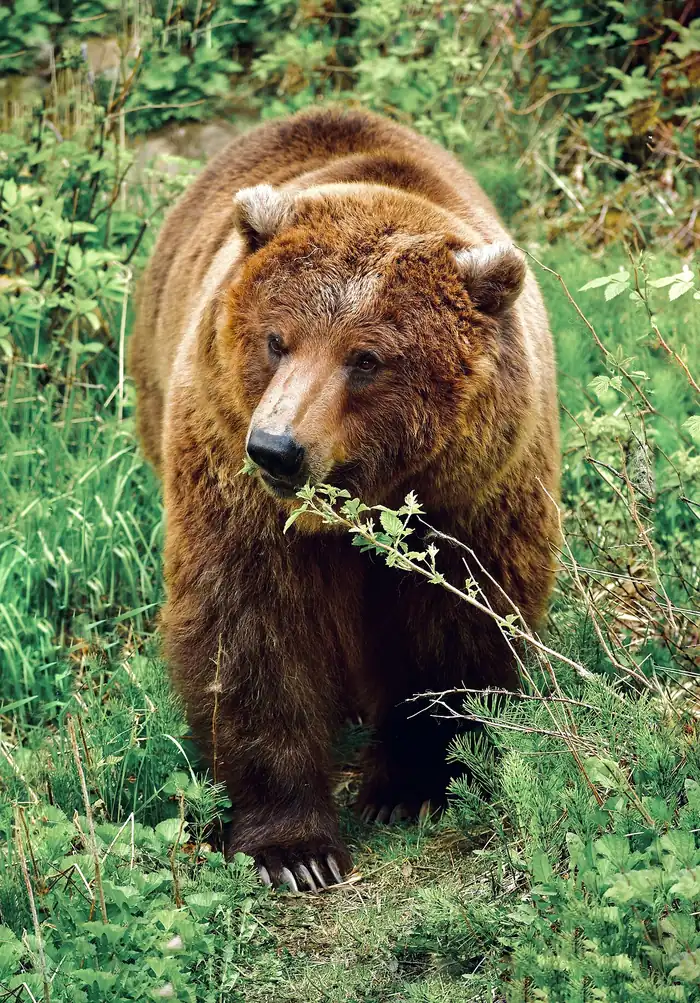
Look for four things, in this order. A grizzly has a prominent shoulder hump, small round ears that look set wide on the head, a dished (concave) face profile, and long, pale, curved claws. A black bear has no hump (or only a tiny one), taller pointed ears, a straight or Roman-nosed profile, and short dark claws. Color is NOT a reliable clue — black bears in the western mountains are often brown, and some "black" bears are nearly blonde. In Montana, west of the Continental Divide and in the isolated north-central recovery zones, a bear in the mountains is more likely a grizzly; anywhere in the valleys you should identify the animal itself before assuming.
Grizzly vs Black Bear: Why the Distinction Matters in Montana
Montana is one of the few places where both North American bears live in the same state, often in the same drainages. Montana Fish, Wildlife & Parks (FWP) manages grizzly bear populations in the Northern Continental Divide (Glacier, the Bob Marshall, and the Cabinet-Yaak) and the Greater Yellowstone ecosystem, and black bears statewide. Getting the identification right is about more than trivia: grizzlies are a protected species with strict rules, black bears are far more common in settled areas, and the two are handled completely differently when they show up near a home, camp, or livestock operation. A homeowner who assumes every brown bear on their property is a grizzly can make bad decisions — and the reverse mistake is even more dangerous.
This guide is about knowing which bear you're looking at and how to read the field marks. It is not removal or control guidance — bears are a protected species in Montana and are managed by FWP, never handled as a do-it-yourself nuisance.
Quick Comparison Table
| Field Mark | Grizzly Bear | Black Bear |
|---|---|---|
| Shoulder hump | Prominent, high muscular hump | None to little; back is level or rump-high |
| Ears | Small, round, set wide and low | Tall, pointed, look prominent |
| Face profile | Dished, concave between snout and forehead | Straight or Roman-nosed, convex |
| Claws | Long (2–4 in.), pale/light-colored, curved | Short (¾–1¼ in.), dark, less curved |
| Rear | Slight hump and slender rear; back profile slopes downhill to a low rump | Rear may sit higher than the front (rump-up climbing profile) |
| Color | Blonde to black — highly variable, not reliable | Black to cinnamon to blonde — not reliable |
| Track | Front track 4–4½ in. wide; claws show well ahead of toes | Front track ½–1 in. smaller; claws close to toes |
| Montana status | Federally protected; FWP managed recovery zones | Common statewide; managed as a big-game species |
The Shoulder Hump: The Single Most Reliable Mark
Look at the bear in profile. A grizzly has a distinct, high shoulder hump — a roll of muscle over the shoulders that makes the back edge uphill to the neck. A black bear has essentially no hump; its back runs fairly level, and when it climbs or walks uphill the rump can look higher than the front. At a distance, the hump is the fastest and most reliable field mark, and it holds even when color, size, and age make everything else ambiguous. A cub can be hard to call, but an adult silhouette rarely is.
Ears and Face: Fine Marks That Confirm the Call
Ears and head shape back up the hump. A grizzly's ears are small and round and sit low and wide on a broad head, so the head reads as flat-topped. A black bear's ears are taller, more pointed, and stick up clearly from a narrower skull — they look like two little triangles. The face also differs in profile: a grizzly has a dished, concave forehead-to-snout line; a black bear's snout runs straight or slightly Roman-nosed (convex). If you can watch the bear turn its head, the dished vs. straight line is a gut-level difference you'll see immediately.
Claws and Tracks: The Ground Evidence
You'll rarely see claws clearly on a live bear, but you'll see them on tracks and trees. A grizzly's front claws are long — 2 to 4 inches — pale, and curved for digging; in a footprint the claw marks extend well out past the toes, and grizzly digs tear up gopher mounds and roots. A black bear's claws are shorter (¾ to 1¼ inches), dark, and less curved, meant more for climbing than digging, so in a track the claws sit close to the toes. A black bear's claw marks also often show high on a gnawed tree trunk where it climbed; a grizzly rarely scratches that kind of vertical bark trail. For how to tell grizzly claw digs from another burrowing animal's work on your property, see our Montana Yard Digging Guide.
Color Is Not the Answer
People assume a black bear is black and a grizzly is brown. In the western mountains especially, this is wrong. Black bears in Montana's forests are frequently cinnamon, dark brown, or even blonde, and grizzlies range from pale blonde to almost black. The gingery ears-and-muzzle look some people tie to grizzlies appears on brown black bears too. Never call the species by color alone — use the hump, ears, and face.
Behavior Around Homes, Yards, and Campsites
Black bears are the species that actually turns up in Montana towns, orchards, and backyards, drawn to bird feeders, trash, fruit trees, and pet food. They climb readily and are the bear behind "bear in the tree over my deck." Grizzlies are more often an issue on ranchland and in the backcountry, though as populations expand they appear in the valleys too. Regardless of species, the trigger is the same — an easy food reward — and the FWP advice is identical: remove bird feeders once bears are active, keep trash in bear-resistant containers and out overnight, clean grills, and never intentionally feed any bear. A bear that becomes food-conditioned is a dangerous bear, and for grizzlies that commonly means management action by FWP. Bear encounters are handled with established avoidance protocols — this is a safety topic, not a do-it-yourself control job, so on live bears always contact or consult Montana Fish, Wildlife & Parks rather than acting on your own.
FAQ: Grizzly vs Black Bear in Montana
Are black bears ever brown in Montana?
Yes, often. Mountain black bears are frequently cinnamon or brown, so a brown bear is not automatically a grizzly. Use the shoulder hump, ear shape, and face profile rather than fur color.
How can I tell a grizzly from a black bear in a photo?
Blow up the focal point and check the hump and ears. A clear shoulder hump and round low-set ears say grizzly; a level back with pointed, upright ears says black bear. Color in a photo is the least reliable cue.
Which bear is more dangerous?
Grizzlies are larger, less predictable in a close encounter, and more apt to act defensively, and they are responsible for more serious attacks in Montana. But any surprised bear can injure you. Follow FWP backcountry protocols: make noise, travel in groups, carry bear spray and know how to use it, and never run from a bear.
Do grizzlies live in eastern Montana?
Grizzlies are essentially a western and north-central Montana animal — the Northern Continental Divide (Glacier and the Bob Marshall), the Cabinet-Yaak, and the Greater Yellowstone ecosystem. Eastern Montana's shortgrass prairie is black bear country.
Can I trap or remove a bear from my property in Montana?
No. Black bears are a managed big-game species and grizzlies are federally protected; neither is a do-it-yourself nuisance. Contact Montana Fish, Wildlife & Parks or a licensed bear-aware professional for any bear repeatedly on your property, and start by removing the food attractant that brings it there.
What should I do if I see a bear near my Montana home?
Give it a wide, quiet escape route and no food reward. Once it leaves, remove whatever attracted it — birdseed, trash, pet food, fallen fruit — and report repeated visits to your regional FWP office. Never approach, even with a vehicle between you and the bear.
Sources: Montana Fish, Wildlife & Parks (FWP), U.S. Fish & Wildlife Service, National Park Service "Be Bear Aware" guidance, and the Greater Yellowstone/Interagency Grizzly Bear Committee field identification materials. This guide is for informational purposes only and does not constitute professional wildlife management or safety advice.