Quick Answer
The fastest way to tell an eastern chipmunk from a ground squirrel: a chipmunk has a bold dark stripe running through each eye, a white stripe bordered by black stripes on each side of the back, and a flat, furry tail it carries upright when moving. Its burrow entrance is a small, clean, round hole (2–3 inches) with no mound of loose dirt, usually tucked near a stone wall, tree root, or foundation. A ground squirrel has a longer, lower body with a shorter tail held flat or straight out behind it, no bold facial stripe pattern, and its burrow entrance features a distinct crescent-shaped mound of excavated soil in open grassland.
Two Small Striped Yard Rodents
Homeowners across the northern United States and southern Canada often spot a small striped rodent darting across the lawn and assume it is a chipmunk. In many cases, especially in the Great Plains and Rocky Mountain regions, the animal is actually a ground squirrel. State wildlife agencies and cooperative extension services regularly field calls from residents trying to identify the holes and tunnels appearing in their yards. The confusion is understandable: both animals are small, burrowing rodents with stripes, and both are active during daylight hours.
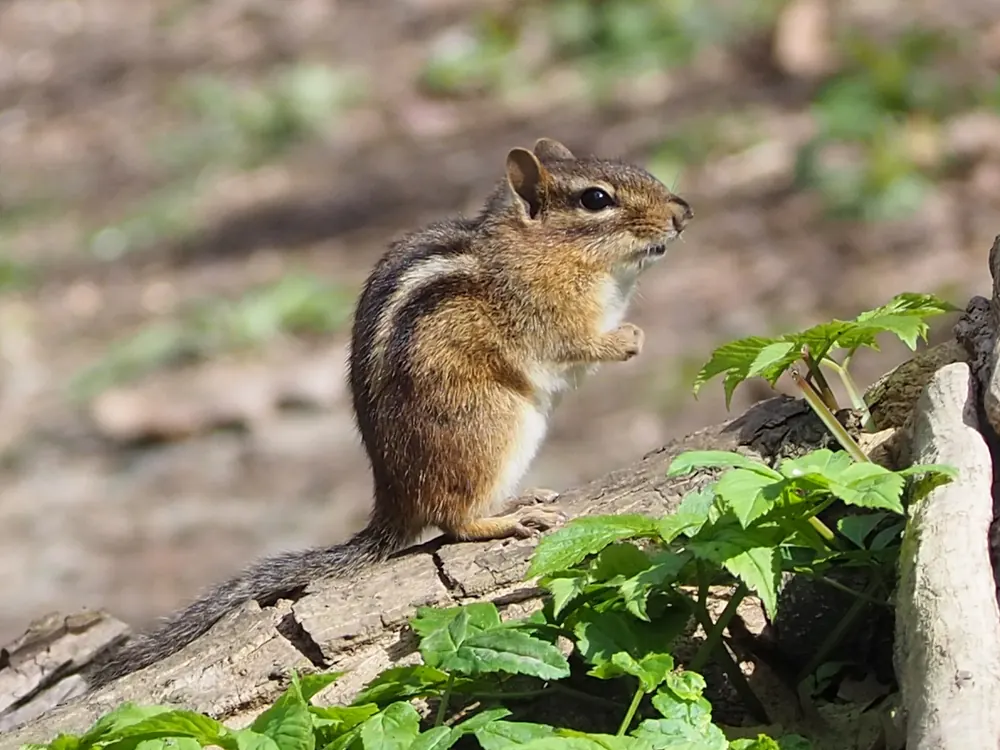
However, the eastern chipmunk (Tamias striatus) and the common ground squirrels of the central and western states—including the thirteen-lined ground squirrel (Ictidomys tridecemlineatus), Richardson's ground squirrel (Urocitellus richardsonii), and Wyoming ground squirrel (Urocitellus elegans)—differ significantly in appearance, behavior, and the type of burrow damage they cause. Understanding these differences helps you identify the animal correctly and respond appropriately, whether that means protecting a garden from chipmunk foraging or managing a ground squirrel colony in a pasture or prairie-like lawn.
Quick Comparison Table
| Feature | Eastern Chipmunk | Ground Squirrel |
|---|---|---|
| Adult size | 5–6 inches body, plus 3–4 inch tail | 6–9 inches body, plus 2–4 inch tail |
| Stripes on face | Dark stripe through each eye; light stripe above and below | No bold eye stripe; face relatively plain or faintly marked |
| Back stripes | White stripe bordered by black on each side; 5 dark stripes total | Alternating dark and light stripes or rows of pale spots (thirteen-lined); no white-bordered-by-black pattern |
| Tail | Flat, furry, carried upright when running | Short, held flat or straight out behind body |
| Body shape | Compact, rounded, somewhat chubby | Longer, lower, more slender profile |
| Burrow entrance | Small, clean, round hole (2–3 inches) | Oval or sloped entrance, often 3–5 inches wide |
| Mound | No mound, or a small scattered cache pile | Crescent-shaped mound of loose excavated soil |
| Behavior | Solitary, shy, darts between cover | Colonial, social, whistles or chirps from burrow edge |
| Habitat | Woodlands, brushy edges, suburban yards with trees | Grasslands, prairies, pastures, lawns with short grass |
| Climbing | Frequently climbs trees, walls, and fences | Rarely climbs; stays on the ground |
The Eastern Chipmunk
The eastern chipmunk (Tamias striatus) is the only chipmunk species found in the eastern United States and southeastern Canada. It is a small, ground-dwelling member of the squirrel family (Sciuridae) that prefers deciduous woodlands, brushy areas, and suburban neighborhoods with mature trees, stone walls, and rock piles.
Size and Appearance
An adult eastern chipmunk measures about 5 to 6 inches in body length with a 3 to 4 inch tail. It weighs between 2.5 and 5 ounces. The most distinctive feature is the facial pattern: a dark brown or black stripe runs through each eye, bordered by lighter stripes above and below. On the back, five dark stripes run from the shoulders to the rump, with a prominent white stripe in the center bordered by black on each side. This white-bordered-by-black pattern is unique to chipmunks among small yard rodents.
Cheek Pouches and Food Storage
Chipmunks have expandable internal cheek pouches that allow them to carry large quantities of seeds, nuts, berries, and even small insects back to their burrows. They are scatter-hoarders and larder-hoarders, caching food in underground chambers connected to their tunnel systems. A single chipmunk may transport hundreds of acorns and seeds over the course of a season, which can lead to sprouting plants in flower beds near their burrows.
Climbing Behavior
Unlike ground squirrels, eastern chipmunks are agile climbers. They regularly scale trees to collect nuts and fruits, and they will climb stone walls, wooden fences, and even the side of a house to reach bird feeders or gain access to attics. This climbing ability is a key behavioral difference from ground squirrels, which rarely leave the ground.
Burrow Characteristics
Chipmunk burrows are typically 2 to 3 inches in diameter with a clean, round entrance. The entrance is often hidden beneath tree roots, alongside a stone wall, under a deck, or near a building foundation. Unlike ground squirrels, chipmunks do not leave a large mound of excavated soil at the entrance. They may scatter a small amount of dirt away from the hole or use a nearby rock or log as a natural cover. The tunnel system can extend 20 to 30 feet with multiple chambers for nesting and food storage.
The Ground Squirrel
Several ground squirrel species dig burrows in yards across the central and western United States. The three most commonly encountered by homeowners are the thirteen-lined ground squirrel (Ictidomys tridecemlineatus), Richardson's ground squirrel (Urocitellus richardsonii), and Wyoming ground squirrel (Urocitellus elegans). These species share many characteristics that distinguish them from chipmunks.
Size and Body Shape
Ground squirrels are generally larger and more elongated than chipmunks. Richardson's ground squirrels, sometimes called "flickertails," measure 7 to 9 inches in body length with a 2 to 4 inch tail. Thirteen-lined ground squirrels are slightly smaller at 6 to 7 inches, while Wyoming ground squirrels fall in between. All have a longer, lower profile with shorter legs and a tail that is held flat against the ground or straight out behind them when they run.
Striping and Coloration
The thirteen-lined ground squirrel has 13 alternating dark and light stripes running down its back, often broken into spots or dashes. Richardson's and Wyoming ground squirrels have more muted coloration with fine speckling or faint stripes, but none of these species have the bold facial stripe through the eye that characterizes chipmunks. Their faces are relatively plain, with no distinct dark eye stripe or white-bordered-by-black pattern on the back.
Social Structure and Vocalizations
Ground squirrels are colonial animals. They live in groups or loose colonies with interconnected burrow systems. Richardson's ground squirrels are particularly social and will whistle or chirp loudly to warn others of approaching danger. Thirteen-lined ground squirrels are somewhat less social but still tolerate nearby burrows. This colonial behavior means that if you see one ground squirrel, there are likely several more in the immediate area.
Habitat and Hibernation
Ground squirrels prefer open grassland, prairies, pastures, and lawns with short vegetation. They avoid dense woodlands. All three species hibernate during the winter months. Richardson's ground squirrels hibernate from late summer or early fall until March or April, while thirteen-lined ground squirrels typically hibernate from October to April. Wyoming ground squirrels have a shorter active season, often hibernating from July or August until the following spring.
Burrow Entrances
Ground squirrel burrow entrances are larger than chipmunk holes, typically 3 to 5 inches in diameter. The entrance is often sloped or oval-shaped rather than perfectly round. The most obvious distinguishing feature is the crescent-shaped mound of loose, excavated soil piled at the entrance. These mounds can be 6 to 12 inches across and several inches high. In a colony, you will see multiple mounds scattered across the lawn or pasture.
Burrows: The Hole Tells the Story
Examining the burrow entrance is often the most reliable way to determine which animal is living in your yard. The differences are consistent across regions and species.
Chipmunk Burrows
A chipmunk burrow entrance is a neat, round hole approximately 2 to 3 inches in diameter. There is no large mound of dirt at the entrance. The chipmunk carries excavated soil away in its cheek pouches and deposits it elsewhere, often scattering it over a wide area or using it to fill in old tunnels. The entrance is typically hidden near cover—under a bush, alongside a stone wall, at the base of a tree, or next to a foundation. You may see a small, scattered pile of dirt or a faint trail leading away from the hole, but not the prominent mound characteristic of ground squirrels.
Ground Squirrel Burrows
Ground squirrel burrows have a distinct mound of loose soil at the entrance. The mound is often crescent-shaped because the squirrel pushes dirt out in one direction while digging. The entrance hole itself is larger (3 to 5 inches) and may be oval or sloped rather than perfectly round. In a colony, you will find multiple entrances within a relatively small area, each with its own mound. The soil is often lighter in color than the surrounding turf because it has been brought up from deeper underground.
Which One Is Digging in My Yard?
To determine which animal is responsible for the holes in your yard, consider the location, the appearance of the burrow, and the timing of activity.
Signs of Chipmunk Activity
If the holes are small (2–3 inches), clean, and located near trees, stone walls, brush piles, or building foundations, you are likely dealing with an eastern chipmunk. Chipmunks are active during the day, especially in the early morning and late afternoon. They are solitary and shy, darting quickly between cover. You will rarely see more than one or two at a time. Chipmunks do not create large dirt mounds, and their activity is concentrated in areas with nearby cover.
Signs of Ground Squirrel Activity
If you see multiple holes with crescent-shaped mounds of loose dirt in an open, grassy area, ground squirrels are the likely culprits. These animals are colonial, so you may see several individuals sitting upright near their burrow entrances or hear their warning whistles. Ground squirrel activity is also diurnal, but they are more visible in open areas because they do not rely on cover. In the Great Plains and Rocky Mountain states, Richardson's and Wyoming ground squirrels are common in yards adjacent to pastures or prairie. Thirteen-lined ground squirrels are widespread across the central United States and are frequently found in suburban lawns with short grass.
Damage Patterns
Chipmunk damage is usually limited to small holes, dug-up flower bulbs, and missing birdseed. They may also gnaw on ripening fruits and vegetables in a garden. Ground squirrels cause more extensive damage. Their burrow systems can undermine lawns, create trip hazards, and damage agricultural crops. Richardson's ground squirrels are particularly notorious for consuming large amounts of forage in pastures and hayfields. The presence of multiple mounds and a colony structure points strongly to ground squirrels rather than chipmunks.
FAQ: Chipmunk vs Ground Squirrel
What is the main difference between a chipmunk and a ground squirrel?
The main difference is the facial stripe pattern and the tail. A chipmunk has a dark stripe through each eye and a white stripe bordered by black on its back, plus a flat, furry tail carried upright. Ground squirrels lack the bold eye stripe, have a shorter tail held flat, and have a longer, lower body profile.
Which one climbs trees and walls?
Eastern chipmunks are agile climbers and regularly scale trees, stone walls, and fences. Ground squirrels are almost exclusively terrestrial and rarely climb anything taller than a low rock or log.
Which one digs colony burrows?
Ground squirrels dig colonial burrow systems with multiple entrances and mounds spread across an open area. Chipmunks are solitary and dig individual burrows hidden near cover, with no visible mound.
Do both animals store food?
Yes, both chipmunks and ground squirrels store food. Chipmunks use expandable cheek pouches to transport seeds and nuts into underground chambers. Ground squirrels also cache food in their burrows, though they rely more heavily on fat reserves built up before hibernation.
Which one is more damaging to a lawn?
Ground squirrels are generally more damaging because they dig extensive colonial burrow systems that create multiple mounds, undermine the soil structure, and can cause significant damage to pastures and lawns. Chipmunk damage is typically limited to small holes and dug-up bulbs near cover.
How can I keep them out of my yard?
Prevention methods include removing rock piles, woodpiles, and brush that provide cover for chipmunks. For ground squirrels, maintaining short grass and installing fencing or exclusion barriers around gardens can help. Habitat modification is the most effective long-term approach. Check with your state wildlife agency or local cooperative extension office for region-specific management recommendations.
Related Identification Guides
For more information on identifying similar yard rodents and the damage they cause, see the following guides:
- Squirrel vs Chipmunk Damage Guide
- Prairie Dog vs Ground Squirrel
- Red Squirrel vs Gray Squirrel
- Flying Squirrel vs Grey Squirrel
- What Animal Is Digging Holes in My Wyoming Yard?
- What Animal Is Digging Holes in My North Dakota Yard?
Sources: Wyoming Game and Fish Department; North Dakota Game and Fish Department; Cooperative Extension Services (University of Wyoming, North Dakota State University, and other land-grant institutions); USDA Forest Service. This guide is for informational purposes only and does not constitute professional wildlife management advice.